
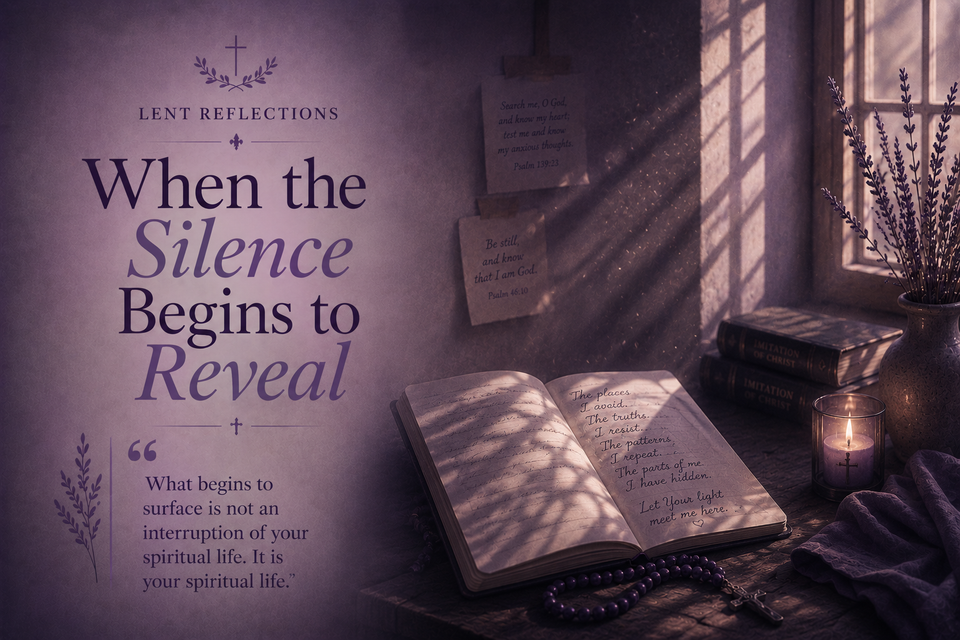
When the Silence Begins to Reveal
There comes a subtle shift in the spiritual life when silence stops feeling like something around us and begins to feel like something within us.
At the beginning of Lent, silence often feels intentional. We choose it. We step away from noise, simplify our routines, fast from certain comforts, and create space for prayer. At first, silence can feel like atmosphere—a setting we enter for the sake of discipline. But as the season deepens, something changes. Silence begins to do more than surround us.
It begins to reveal us.
And that can be deeply unsettling.
Because many of us imagine spiritual progress as increasing calm, greater emotional steadiness, and fewer internal disruptions. We assume that if we are praying faithfully, growing spiritually, or healing well, certain thoughts should disappear. Certain emotions should no longer surface. Old attachments should feel permanently resolved.
So when memories unexpectedly resurface, when old emotions reappear, or when something we thought we had already surrendered suddenly feels strangely present again, the immediate instinct is often discouragement.
Why is this still here?
I thought I was past this.
Am I going backwards?
But perhaps the more honest spiritual interpretation is not regression.
Perhaps it is revelation.
One of the most important truths Lent teaches is that it does not create what is within us.
It reveals it.
That distinction matters.
Because what surfaces in silence was not necessarily caused by silence. It may simply have been hidden beneath distraction, busyness, emotional noise, or constant outward attention. When those layers begin to fall away, what remains becomes visible—not because something new was created, but because something previously obscured can finally be seen.
And being seen is not the same thing as failing.
In fact, revelation is often a form of grace.
That can be difficult to accept because exposure rarely feels comforting. Most of us would prefer a spiritual life that feels peaceful at the surface. We would prefer prayer to reassure rather than expose. We would prefer silence to soothe rather than uncover.
But God is not primarily interested in surface peace.
He desires truth.
That is the posture of Psalm 139:
“Search me, O God, and know my heart.”
That prayer is beautiful—but it is also vulnerable.
Because to invite God to search us is to allow ourselves to be seen honestly. Not the composed version of ourselves. Not the spiritually polished version. Not the version that insists everything is fine.
The real self.
The self with hidden fears.
Unresolved attachments.
Quiet anxieties.
Patterns we would rather believe are gone.
That kind of revelation can feel uncomfortable.
But discomfort does not necessarily mean something has gone wrong.
Sometimes discomfort simply means something hidden has become visible.
And what becomes visible can be healed.
This is one of the reasons the wisdom of the Desert Fathers remains so compelling. Abba Arsenius, who once lived in prestige, influence, and imperial life, left all of it behind in pursuit of silence and hiddenness. His prayer was remarkably simple:
“Lord, lead me in the way of salvation.”
But silence did not immediately give him clarity.
It gave him purification.
That distinction feels deeply relevant.
Because many of us enter silence hoping for answers.
But often, silence answers differently.
Not with explanation.
With exposure.
And exposure is not cruelty.
It is invitation.
Saint Teresa of Ávila offers another deeply beautiful lens for understanding this. Her imagery of the soul as an Interior Castle reminds us that the spiritual life is not flat. The soul contains many rooms, many chambers, many layers of movement and awareness.
And most of us spend much of our lives in the outer rooms.
The reactive rooms.
The noisy rooms.
The rooms filled with external urgency, distraction, emotional management, and surface-level peace.
But seasons like Lent gently invite movement inward.
Not to overwhelm us.
To illuminate us.
God does not violently expose the soul.
He reveals gently.
Tenderly.
Patiently.
Only when there is enough quiet for truth to emerge without destroying us.
That is extraordinary mercy.
Because revelation is not condemnation.
It is invitation into deeper honesty.
This is also where spiritual warfare becomes particularly deceptive.
Because when old emotions resurface, the enemy often whispers familiar accusations:
You’re going backwards.
You haven’t healed.
Nothing has changed.
But revelation is not regression.
Exposure is not failure.
What begins to surface is not an interruption of your spiritual life.
It is your spiritual life.
That may be one of the most important reversals in this reflection.
Because so often we interpret spiritual discomfort as evidence that something has gone wrong, when in reality, the discomfort may be evidence that deeper work has finally begun.
The desert is not only emptiness.
It is unveiling.
When distractions lose their grip, what remains becomes visible. And visibility can feel profoundly uncomfortable, especially if we were attached to the illusion of being “past” something.
But honest visibility is spiritually necessary.
Because transformation cannot happen where truth is constantly avoided.
And perhaps this is why Lent becomes something deeper than discipline.
It becomes encounter.
Not simply with God in abstraction.
But with God in truth.
And sometimes, that truth includes seeing ourselves more honestly than we expected.
That can feel humbling.
But it can also be profoundly healing.
Because God was never waiting for the polished version of you.
He was waiting for the real one.
And perhaps the most beautiful reversal of all is this:
God was not absent in the silence.
He was present in what it revealed.
If You Want to Sit With This Reflection
- Psalm 139 — Honest self-examination before God
- Abba Arsenius — Silence and hidden purification
- Saint Teresa of Ávila — The Interior Castle
- Matthew 6:6 — The hidden place of prayer
Some reflections feel different when they’re heard.
Member discussion