
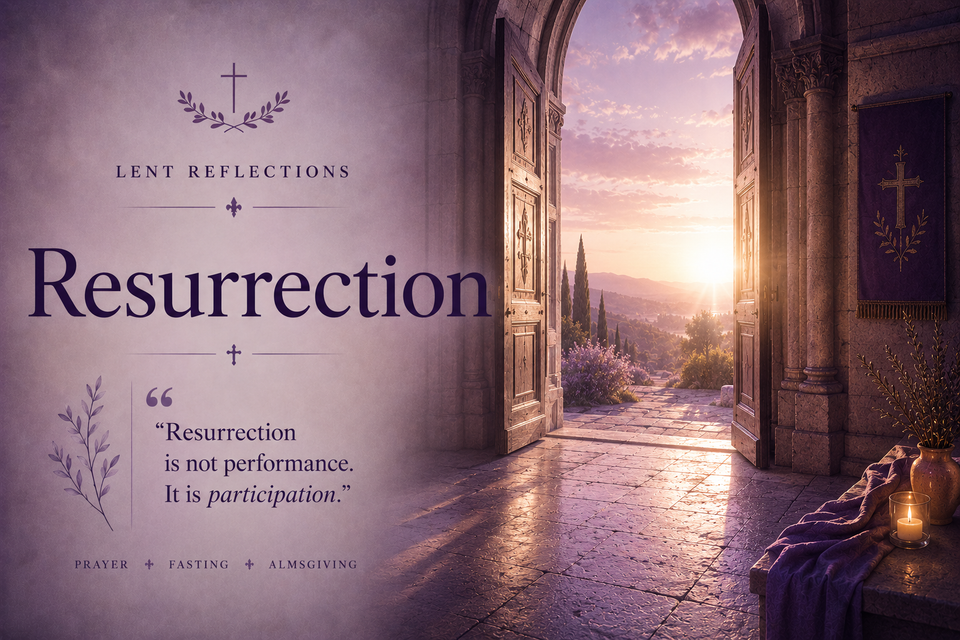
Resurrection
There are certain truths in Christianity that are so familiar they risk becoming merely symbolic in our minds.
Resurrection is one of them.
We hear the words every Easter. He is not here. He has risen. We sing them, proclaim them, celebrate them. And yet the familiarity of those words can sometimes soften their force.
Because Christianity does not begin with a metaphor.
It begins with an event.
Jesus Christ truly died.
He was truly buried.
And He truly rose bodily from the dead.
That claim is not poetic symbolism, emotional encouragement, or spiritual abstraction.
It is the historical foundation of the Christian faith.
And if that is true, then everything changes.
Because if Christ truly rose, then suffering is not meaningless.
Death is not final.
Silence was not abandonment.
Waiting was not emptiness.
And everything the soul walked through during Lent is reframed—not as pointless discomfort, but as preparation for life.
That is what makes Resurrection so extraordinary.
It is not merely something remembered liturgically.
It is the fulfillment of everything the season was preparing the soul to receive.
And perhaps one of the most beautiful spiritual truths is that resurrection does not remain only historical.
It becomes participatory.
Christianity does not ask us merely to believe in Resurrection as an external fact.
It invites us to enter it.
Saint Paul’s language in Romans is deeply clear on this: Resurrection is not only something Christ experienced. It becomes the Christian’s invitation into newness of life.
That changes how we understand transformation.
Because resurrection in the soul does not always arrive dramatically.
It may not feel triumphant.
It may not resemble emotional spectacle.
It may not come with tears, overwhelming breakthroughs, or unmistakable spiritual intensity.
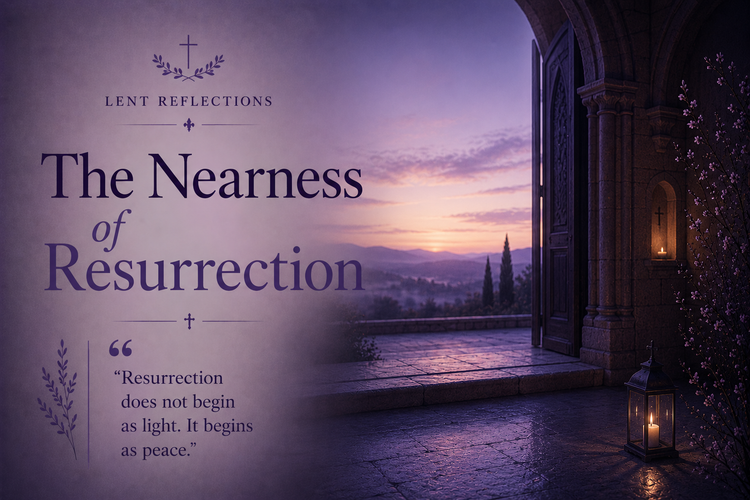
Sometimes resurrection begins much more quietly than we expect.
As peace.
As spaciousness.
As subtle freedom.
As realizing that something which once governed you no longer does.
That does not make it less real.
If anything, it makes it profoundly trustworthy.
Because grace often works more quietly than our emotional expectations.
One of the spiritual temptations many people face is assuming that unless transformation feels dramatic, nothing happened.
Unless there is emotional euphoria, dramatic clarity, or obvious internal fireworks, perhaps grace was absent.
But that is rarely how God’s deepest work unfolds.
God often transforms in hidden places.
Quietly.
Faithfully.
Gradually.
And perhaps this is where Lent prepares us most honestly for Easter.
Because everything that came before—the desert, the silence, the unveiling, the purification, the hidden interior work—was never separate from Resurrection.
It was preparation for it.
The struggle may not have fully disappeared.
Certain thoughts may still appear.
Memories may still surface.
Some areas of healing may still remain unfinished.
But the question is no longer whether all struggle vanished.
The question is whether struggle still governs.
That distinction matters deeply.
Because transformation is not always the disappearance of difficulty.
Sometimes transformation is diminished authority.
The thought still comes.
But it no longer commands.
The old pattern still presents itself.
But it no longer controls your response.
The memory still exists.
But it no longer defines the moment.
That is not emotional self-control alone.
That is grace.
And perhaps that is one of the most honest ways resurrection begins in the soul.
Not through dramatic triumph.
Through quiet reordering.
This is why one of the most theologically important truths in the Christian life is this:
Christ did not rise so that nothing would ever hurt again.
He rose so that suffering would no longer be meaningless.
So that death would no longer have the final word.
So that despair would no longer possess ultimate authority.
That distinction matters profoundly.
Because Christianity has never promised the elimination of human suffering.
It promises redemption.
And redemption changes suffering from the inside.
That applies not only to Christ’s Passion.
It applies to our own lives.
Because resurrection often looks less like escape and more like transformation.
Less like emotional perfection and more like renewed life.
Less like spectacle and more like participation.
That may be one of the most mature spiritual invitations Easter offers.
Not performance.
Participation.
Not proving transformation.
Receiving it.
Not demanding dramatic evidence.
Recognizing quiet grace.
And perhaps this is why some of the deepest Easter joy does not arrive loudly.
It arrives as a strange and quiet certainty.
A joy that rises gently from within.
A silence that no longer feels empty, but full.
A realization that something has happened that changes everything.
Even if not everything feels fully complete yet.
Philippians reminds us that the God who began the work is the God who faithfully brings it to completion.
So Easter is not merely the announcement that Christ rose.
It is also the assurance that God completes what He begins.
That includes us.
And perhaps this is the most honest Easter examination of all:
Where am I already different?
What no longer governs me?
What once consumed me that no longer carries the same authority?
Those questions matter because resurrection is not only something we proclaim.
It is something we begin to recognize.
And perhaps even something we begin to inhabit.
Because resurrection is no longer merely something we are waiting for.
In Christ—
it has already begun.
If You Want to Sit With This Reflection
- Matthew 28 — The Resurrection of Christ
- Romans 6 — Newness of life
- Philippians 1:6 — God completes what He begins
- 1 Corinthians 15 — The victory of Resurrection
Some reflections feel different when they’re heard.
Member discussion