
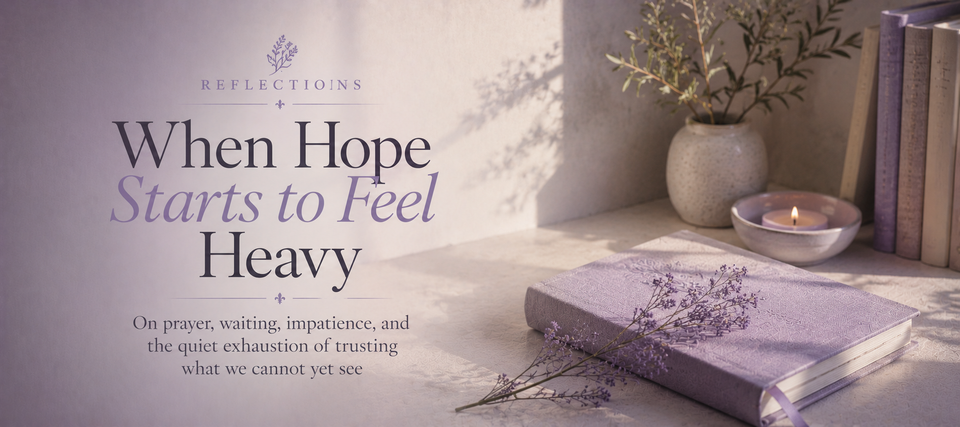
When Hope Starts to Feel Heavy
There are seasons in life when prayer feels natural.
Words come easily.
Hope feels alive.
Faith feels emotionally accessible.
Trust feels less like effort and more like instinct.
And then there are other seasons.
Seasons where prayer is still present, but something about it feels heavier.
Not because faith has disappeared.
Not because gratitude is gone.
Not because God has somehow become less good.
But because waiting has stretched longer than expected.
And hope, when held for a long time, can begin to feel surprisingly weighty.
This is not something we talk about often.
At least not honestly.
We speak easily about trust when trust feels inspiring.
We speak beautifully about surrender when surrender sounds poetic.
We quote verses about waiting on the Lord when waiting still feels noble.
But the lived reality of waiting can feel very different.
Because waiting is not always peaceful.
Sometimes waiting is restless.
Sometimes waiting is uncertain.
Sometimes waiting reveals how attached we were—not necessarily to a particular outcome—but to a particular timeline.
And perhaps that is where some of the deeper tension begins.
Because many of us do trust God.
Truly.
And still find ourselves quietly wondering:
How long?
Not always dramatically.
Not in anger.
Sometimes simply in fatigue.
Not because we have stopped believing that God hears prayer.
But because we are human enough to wonder whether the answer we hope for belongs to our lived experience… or only to mystery.
That is a difficult place to inhabit.
Especially for people of faith.
Because spiritual exhaustion can sometimes feel embarrassing.
As if mature faith should look endlessly steady.
As if trust should always feel emotionally strong.
As if true surrender should remove impatience entirely.
But that has never really been the witness of Scripture.
The Psalms are full of longing.
Full of waiting.
Full of unanswered questions.
Full of human beings bringing their impatience, confusion, grief, and hope directly before God.
“How long, O Lord?”
Not whispered once.
Repeated.
There is something strangely comforting about that.
Because it reminds us that spiritual maturity has never meant emotional numbness.
It has never meant pretending that time does not affect us.
It has never meant becoming the kind of person who waits indefinitely without feeling the ache of waiting.
Faith does not erase human longing.
Sometimes it simply gives longing somewhere to go.
And yet even when prayer remains, something subtle can happen over time.
The emotional texture changes.
The initial fervor softens.
The urgency becomes quieter.
Not necessarily because trust deepens in a serene, cinematic way.
Sometimes because fatigue enters the room.
There is a particular kind of exhaustion that comes not from suffering itself, but from sustained anticipation.
The emotional labor of hoping.
Of continuing to believe something may move.
Of continuing to place desire before God.
Of continuing to live in the space between prayer and visible outcome.
That space can be deeply tiring.
Especially because uncertainty asks so much of us.
A closed door is painful.
A clear no can be painful.
But ambiguity carries its own burden.
Because uncertainty keeps hope partially alive.
And hope, while beautiful, is not emotionally weightless.
Hope stretches.
Hope asks endurance.
Hope keeps part of the heart open.
And open things are vulnerable.
Perhaps that is why waiting can feel so spiritually complex.
Because we are not merely dealing with patience.
We are dealing with desire.
Expectation.
Attachment.
Control.
Trust.
And our relationship to time itself.
It is easy to say we trust God.
It is harder to notice how specifically we may trust Him to act according to our internal calendar.
That realization can be uncomfortable.
Not because desire is wrong.
But because waiting reveals the places where trust and timing have become entangled.
Many of us do not simply pray for outcomes.
We quietly imagine their arrival.
We build emotional timelines.
We anticipate movement.
We rehearse relief.
And when those imagined timelines dissolve, something in us can grow tired—not of God, necessarily—but of anticipation itself.
That distinction matters.
Because spiritual fatigue is not always unbelief.
Sometimes it is simply human limitation meeting prolonged uncertainty.
And human limitation is not moral failure.
It is part of creatureliness.
We are finite.
Time affects us.
Ambiguity affects us.
Waiting affects us.
Even holy people experienced this.
Abraham knew what it meant to wait.
Sarah knew what it meant to wait.
Israel knew what it meant to wait.
The disciples knew what it meant to wait in confusion between promise and understanding.
The Christian story is not a story that avoids waiting.
It is saturated with it.
And perhaps that tells us something important.
Waiting is not evidence that something has gone wrong.
But that does not mean waiting feels easy.
Sometimes what makes waiting particularly exhausting is not merely uncertainty.
It is the hidden question underneath it:
Will I actually see this?
Not abstractly.
Not eventually in some symbolic sense.
But concretely.
In this life.
In a recognizable way.
That question can be spiritually tender.
Because it touches hope at a very vulnerable point.
It asks whether expectation should remain emotionally active or slowly be released into mystery.
And not all seasons make that discernment clear.
Sometimes we genuinely do not know.
Which may be one of the most difficult spiritual realities to accept.
Because uncertainty rarely offers emotional closure.
It asks trust without conclusion.
And trust without conclusion can feel profoundly costly.
Especially in cultures that are conditioned toward immediacy.
We are not formed for slow timelines.
We are formed for response.
Confirmation.
Resolution.
Movement.
But prayer does not always operate according to the emotional expectations we bring to it.
Nor does God seem especially interested in conforming Himself to our preferred pacing.
That can be frustrating.
And naming that honestly is not irreverence.
It is honesty.
There is a difference.
Because honesty before God is not disrespect.
If anything, it may be one of the purest forms of relationship.
The Psalms certainly suggest as much.
God has never required polished emotional performance.
Only truth.
And sometimes the truth is:
I still trust You. I am just tired.
That sentence carries extraordinary humanity.
And perhaps extraordinary faith.
Because there is something profoundly sincere about remaining in relationship even when emotional momentum has faded.
Not dramatic devotion.
Not emotional intensity.
Simple continued presence.
There is also another subtle spiritual temptation in seasons like this.
The temptation to assume that because hope feels heavier, faith must be weaker.
But emotional heaviness is not always spiritual decline.
Sometimes it is simply evidence that we are carrying something meaningful for a long time.
Even love can feel heavy.
Even hope can feel heavy.
That does not make them false.
Still, there may come moments when part of us wants relief not from suffering itself, but from expectation.
A strange desire to stop anticipating simply because anticipation has become exhausting.
And perhaps this is where surrender takes on a different shape.
Not the romantic surrender of inspirational quotes.
But the quieter surrender of loosening our grip on timeline.
Of releasing the need to emotionally manage possibility.
Of allowing trust to exist without constant internal forecasting.
That is difficult work.
Deeply human work.
Spiritual work.
And perhaps it looks less dramatic than we imagine.
Perhaps surrender sometimes sounds like:
I still care deeply. I simply cannot carry this with the same emotional intensity every day.
That is not indifference.
That may actually be wisdom.
Because trust is not the same thing as constant emotional activation.
Hope does not require perpetual adrenaline.
Faith is not measured by how intensely we feel anticipation.
Sometimes faithful waiting becomes quieter.
Less emotionally loud.
Not because desire disappeared.
But because the soul is learning a different relationship to uncertainty.
And perhaps even a different relationship to God.
One less transactional.
Less tied to visible timelines.
More rooted in presence.
This does not mean becoming detached in a cold sense.
Nor pretending desire no longer exists.
It means allowing desire to remain without letting anticipation consume interior peace.
That is easier to write than to live.
But perhaps much of spiritual formation is.
And perhaps grace meets us there—not when we perform serenity, but when we tell the truth.
Because God is not threatened by impatience.
Not surprised by fatigue.
Not scandalized by our humanity.
He knows exactly what it means to be finite.
Which means perhaps the invitation is not to become less human.
But to become more honest within our humanity.
If hope has started to feel heavy, perhaps that does not mean you are doing faith incorrectly.
Perhaps it simply means you have been carrying longing for a long time.
And longing is not light.
Still, even here, grace remains.
Not always as visible answers.
Not always as immediate resolution.
Sometimes simply as enough strength for another honest prayer.
Or perhaps, when words feel tired—
simply enough presence to remain.
Member discussion