
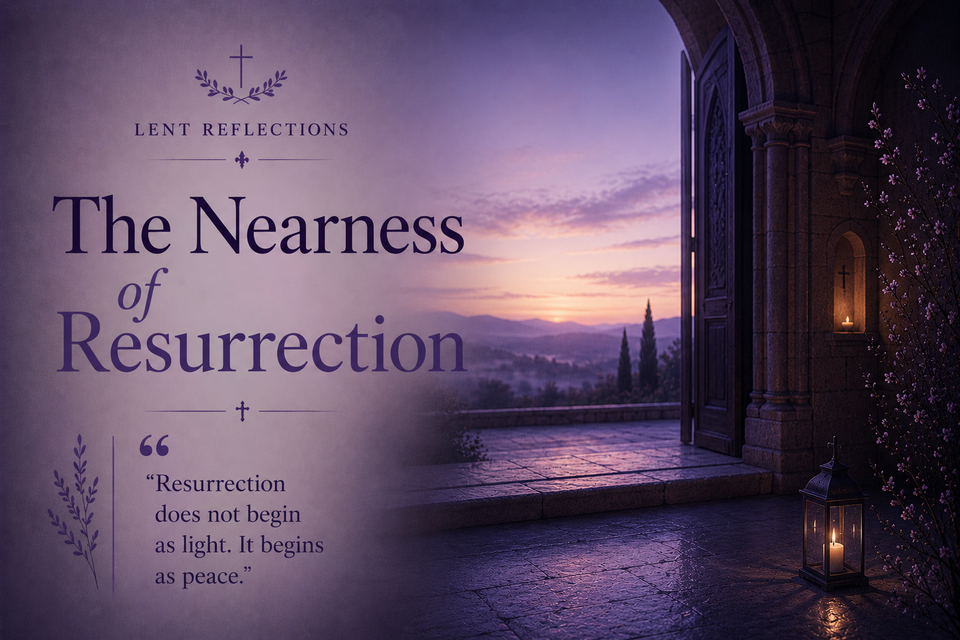
The Nearness of Resurrection
There is a particular kind of transformation that is difficult to describe because it does not arrive dramatically.
Nothing obvious may have changed. The external circumstances may look exactly the same. The thoughts may still occasionally appear. Certain memories may still surface. And yet, something feels different.
Softer.
Less urgent.
Less internally demanding.
You may struggle to explain exactly what shifted, only to realize that something which once carried enormous emotional weight no longer governs you in the same way.
And perhaps that is one of the quietest signs of grace.
Because transformation in the spiritual life rarely announces itself with spectacle.
It often unfolds gently.
Hidden.
Gradual.
Almost imperceptible at first.
This is one of the most mysterious realities of spiritual formation: some of God’s deepest work happens in silence, long before we can name what has changed.
By this point in Lent, many people begin to notice something subtle. The intensity that marked the earlier weeks may begin to soften. The resistance that once felt immediate may no longer feel as strong. The internal grasping may quiet. The need to force, explain, manage, or spiritually “perform” may begin to loosen.
Not because the journey is over.
But because something has been quietly unfolding beneath the surface.
This is important, because we often expect transformation to be obvious.
We expect dramatic clarity.
Emotional breakthrough.
Visible victory.
Proof.
But grace does not always move that way.
Sometimes grace works more like light entering a room without sound.
Nothing seems to happen all at once.
And yet gradually, everything becomes easier to see.
The spiritual life often unfolds in precisely this way.
Philippians 1:6 offers one of the most comforting truths in Scripture:
“He who began a good work in you will bring it to completion.”
That verse is profoundly reassuring because it reminds us that spiritual transformation is not self-engineered.
It is not primarily a project of spiritual performance.
It is not sustained by emotional intensity.
It is not measured by how dramatically we feel.
It is God’s work.
And God’s work is often quieter than we expect.
This is something the contemplative tradition has always understood.
Saint John of the Cross wrote about purification not as spectacle, but simplification—a gradual emptying that makes deeper presence possible. Saint Teresa of Ávila described the soul’s movement toward God not as sudden emotional upheaval, but as hidden interior progression, room by room, chamber by chamber, often unnoticed until much later.
The deepest transformations are not always the loudest ones.
Sometimes they are the most hidden.
And perhaps that is exactly what makes them so trustworthy.
Because transformation is not always the disappearance of struggle.
Sometimes transformation is the diminished power of struggle.
That distinction matters deeply.
Because many people assume healing or sanctification means the complete absence of difficult thoughts, emotional movement, temptation, or internal tension.
But often, the real evidence of grace is subtler than that.
The thought may still come.
But it no longer commands.
The memory may still surface.
But it no longer defines the moment.
The discomfort may still exist.
But it no longer governs your response.
That is real transformation.
Not because everything vanished.
But because its authority diminished.
And sometimes that shift can feel almost strange.
A quiet peace that feels unfamiliar.
An emotional spaciousness that cannot be fully explained.
A surprising ability to remain present without grasping.
A softer relationship with what once consumed you.
This is often where the temptation becomes particularly deceptive.
Because if transformation is subtle, the spiritual temptation is to assume nothing happened.
To demand dramatic proof.
To dismiss quiet grace because it does not feel emotionally cinematic.
To assume that unless something spectacular occurred, growth did not happen.
But grace rarely performs for our reassurance.
Grace transforms.
Quietly.
Faithfully.
Gradually.
And often in hidden places.
This is why resurrection hope begins long before Easter morning.
Because resurrection is not only an event we commemorate.
It is also a pattern God writes into the soul.
Not all at once.
Not always visibly.
But truly.
One of the most beautiful truths in this reflection is this:
Resurrection does not begin as light.
It begins as peace.
That may feel surprising, because we often imagine resurrection as dramatic breakthrough, radiant clarity, emotional triumph, or unmistakable victory.
But spiritually, resurrection often begins much more quietly than that.
As interior steadiness.
As a strange capacity to remain.
As the softening of resistance.
As peace that no longer needs to prove itself.
As the realization that you are no longer standing in exactly the same place within your own story.
That is grace.
And grace often asks to be received before it is fully understood.
This can feel uncomfortable for minds that want explanation.
But not everything real needs to be fully analyzed before it can be trusted.
Some things are meant to be received.
That is part of spiritual maturity too.
Learning to recognize grace without demanding performance from it.
Learning to receive transformation even while it remains partially hidden.
Learning to trust what God has been quietly doing in places beyond immediate awareness.
Because perhaps the truth is this:
Lent does not end suddenly.
It transforms.
And what began in silence, discomfort, unveiling, and purification may already be bearing fruit.
Even now.
Resurrection is no longer far.
It is near.
If You Want to Sit With This Reflection
- Philippians 1:6 — God’s faithful ongoing work
- Saint John of the Cross — Quiet purification
- Saint Teresa of Ávila — Hidden interior transformation
- Romans 8:11 — Resurrection life already at work
Some reflections feel different when they’re heard.

Member discussion