
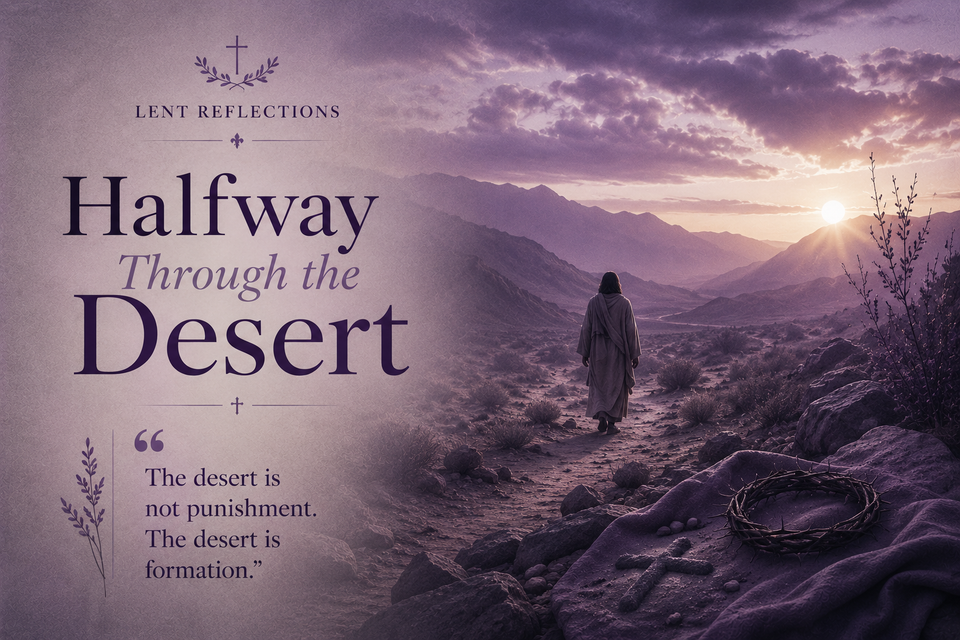
Halfway Through the Desert
There comes a particular moment in Lent when the enthusiasm begins to fade.
The beginning often feels intentional, even energizing. We choose our fasts, make our commitments, perhaps even feel a certain spiritual clarity in saying yes to the season. But somewhere in the middle, something shifts. The novelty wears off. The discipline becomes harder. Prayer feels quieter. Silence begins to feel less peaceful and more uncomfortable.
And if we are honest, this is often the moment when many people quietly wonder whether they are doing something wrong.
Why does prayer feel dry?
Why does God feel quieter?
Why is fasting suddenly more difficult?
Why are uncomfortable emotions surfacing now?
But perhaps the better question is this:
What if this is exactly where we are meant to be?
One of the great misunderstandings about Lent is the assumption that discomfort means failure. That spiritual dryness means distance. That silence means absence.
But Christian tradition suggests something far more profound.
Lent is the desert.
And the desert, spiritually speaking, has never primarily been a place of punishment.
It is a place of formation.
That distinction changes everything.
Because the desert is not simply a barren landscape in Scripture. It is a recurring place of encounter. Moses encountered God in the wilderness. Elijah encountered Him there. John the Baptist lived in the desert. Christ Himself entered the wilderness for forty days before beginning His public ministry.
The biblical pattern is difficult to ignore.
The desert is not abandonment.
It is preparation.
And perhaps even more tenderly, it is intimacy.
The prophet Hosea offers one of the most striking images of this spiritual reality:
“Therefore, I will allure her; I will lead her into the wilderness and speak tenderly to her.” (Hosea 2:14)
That verse completely reframes how we often interpret spiritual dryness.
The wilderness is not presented as rejection.
It is presented as invitation.
God does not always meet us in noise.
Sometimes He meets us precisely where distractions have been stripped away.
And that can feel deeply uncomfortable.
Because once the noise quiets, something else becomes audible.
Ourselves.
Our attachments.
Our anxieties.
Our hidden dependencies.
The things we normally keep numbed through busyness, stimulation, comfort, distraction, even constant emotional motion.
This is one of the reasons desert spirituality remains so compelling.
The desert strips.
Not to humiliate us.
To reveal us.
And what becomes visible in stillness is often exactly what God intends to heal.
This is why the witness of the Desert Fathers feels surprisingly relevant even now.
In the third and fourth centuries, some Christians withdrew into the deserts of Egypt, Syria, and Palestine, not because they hated the world, but because they feared comfort was softening radical discipleship. They sought silence, simplicity, restraint, and direct encounter with God.
Their lives can seem extreme to modern sensibilities, but their spiritual insight remains profoundly human.
Abba Moses the Black famously said:
“Go, sit in your cell, and your cell will teach you everything.”
What a startling sentence.
Because it suggests that stillness itself becomes a teacher.
Not because silence magically fixes us, but because silence reveals us.
And revelation can feel uncomfortable.
When external noise disappears, internal noise often gets louder first.
Restlessness surfaces.
Emotional fatigue appears.
Old attachments become visible.
Desires we thought were under control suddenly feel obvious.
We realize how often we reach for distraction simply to avoid being alone with ourselves.
That is not failure.
That is exposure.
And exposure is often where purification begins.
Abba Anthony also warned that there would come a time when spiritual sanity would appear irrational to the world.
That feels remarkably contemporary.
Because ours is a world built on stimulation, speed, distraction, self-protection, and endless outward attention. Silence feels strange. Simplicity feels restrictive. Restraint feels unnecessary.
And yet Christian holiness has always contained something deeply countercultural about it.
Not performatively severe.
Simply ordered differently.
Toward God instead of constant consumption.
Toward interior clarity instead of endless noise.
Toward surrender instead of self-management.
This is why spiritual warfare often feels particularly visible in Lent.
Not necessarily because God has become distant.
But because distractions have become fewer.
And once distractions fall away, attachments become easier to see.
False comforts become more obvious.
The things we habitually use to regulate ourselves no longer feel as available.
And what rises can feel unsettling.
But discomfort is not necessarily evidence that something is wrong.
Sometimes discomfort is evidence that something hidden has become visible.
And what becomes visible can be healed.
That may be one of the most freeing truths of Lent.
Because it means spiritual dryness is not automatically a sign of distance from God.
Sometimes dryness is simply what happens when emotional or spiritual consolations are no longer carrying the experience.
Sometimes silence is where deeper trust begins.
And perhaps that is why Lent can feel both difficult and strangely sacred at the same time.
Because the desert is honest.
It removes illusion.
It removes excess.
It asks us to sit with what remains.
And that can feel vulnerable.
But vulnerability before God is not punishment.
It is intimacy.
Most of us will never live in the Egyptian desert.
But we can create small deserts in ordinary life.
Moments without noise.
Prayer without multitasking.
Silence without immediate escape.
Intentional restraint.
Interior honesty.
Space where God is allowed to meet us without competition.
These modern deserts may look smaller, quieter, less dramatic.
But spiritually, they carry the same invitation.
To be stripped of what is unnecessary.
To become aware of what is surfacing.
To allow purification without panic.
To stop interpreting silence as abandonment.
And perhaps simply to be still long enough to hear the tenderness of God.
Because the desert is not punishment.
The desert is formation.
If You Want to Sit With This Reflection
- Hosea 2:14 — God speaks tenderly in the wilderness
- Matthew 4:1–11 — Christ in the desert
- 1 Kings 19 — Elijah in the wilderness
- Abba Moses the Black — Sit in your cell, and your cell will teach you everything
- Saint Anthony the Great — Desert wisdom on silence and spiritual vigilan
Some reflections feel different when they’re heard.
Member discussion