
Why Stories Reveal Us
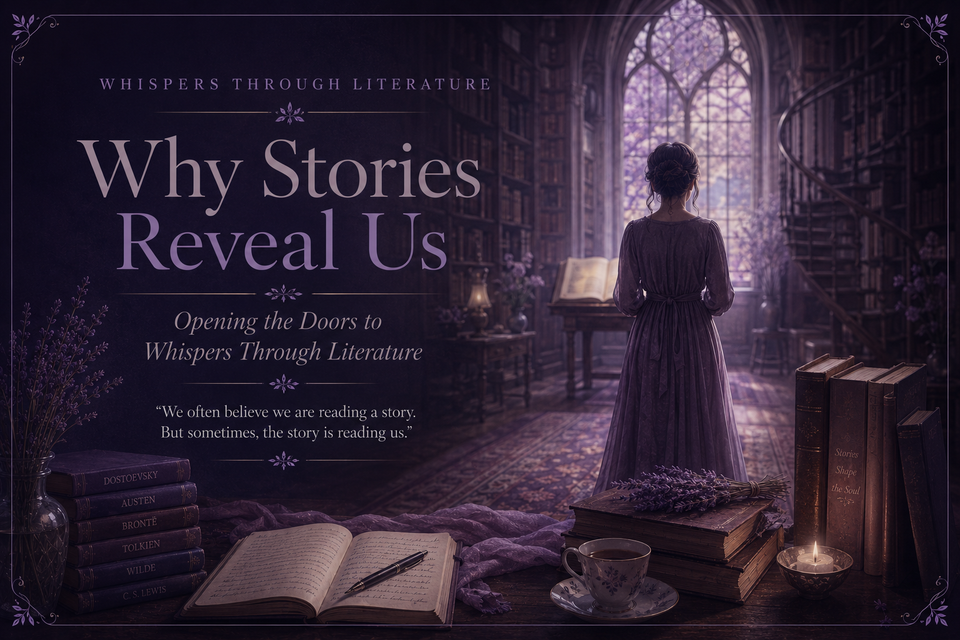
There are books I barely remember.
Books I enjoyed while reading and then quietly returned to the shelf.
I finished them, appreciated them, and eventually moved on.
And then there are other books.
Books that seem to follow us.
Books that refuse to remain on the shelf where we left them.
Years later we still think about them.
Certain scenes return unexpectedly.
Certain characters remain strangely alive in our memory.
Certain questions continue unfolding long after the final page.
And I have often wondered why.
Why do some stories stay with us while others disappear?
Not because they are necessarily the most popular.
Not because they are the most exciting.
And not even because they are the most beautifully written.
I suspect something deeper is happening.
I think some stories remain because they touched something true.
Not merely something true about the world.
Something true about us.
Perhaps that is why literature has always mattered.
Human beings have told stories for as long as human beings have existed. Around campfires. Around dinner tables. Through myths, poems, sacred texts, novels, and songs. Long before modern psychology attempted to explain human behavior, stories were already helping us explore the human experience.
Stories allow us to enter lives that are not our own.
They allow us to experience loves we have never lived, griefs we have never suffered, mistakes we have never made, and choices we have never faced.
And in doing so, they expand our understanding of what it means to be human.
But I think great literature does something even more interesting than that.
It does not merely allow us to observe other people.
It helps us observe ourselves.
A novel may introduce us to a character who struggles with pride.
And suddenly we begin noticing our own.
A story may explore jealousy.
And we discover emotions we would rather not admit are there.
A character may long for love, belonging, freedom, recognition, meaning, or redemption.
And unexpectedly, we recognize ourselves in the longing.
That recognition can be uncomfortable.
But it can also be illuminating.
Because stories often bypass our defenses.
A direct conversation might make us feel criticized.
A story invites us to see.
To reflect.
To recognize.
To choose.
Perhaps that is one reason Christ taught through parables.
Stories reveal truth in a way facts alone sometimes cannot.
They engage not only the intellect but also the imagination.
And the imagination is one of the places where transformation often begins.
This is why I sometimes think we approach literature backwards.
We assume we are studying a story.
But often the story is studying us.
It reveals our assumptions.
Challenges our certainties.
Questions our desires.
And exposes parts of ourselves we may not have noticed before.
The greatest stories are not merely narratives.
They are mirrors.
Not perfect mirrors.
Not literal mirrors.
But mirrors nonetheless.
And perhaps that is why they endure.
Because while technology changes, cultures change, and societies change, the human heart remains remarkably recognizable. We still long. We still hope. We still love. We still fear. We still search for meaning.
The circumstances may differ.
The clothing changes.
The language changes.
The setting changes.
But the human soul remains familiar.
And perhaps that is why a novel written two hundred years ago can still feel astonishingly relevant today.
Not because the world has remained the same.
But because we have.
At least in the ways that matter most.
This is one of the reasons I wanted to create Whispers Through Literature.
Not simply to discuss books.
Not to produce literary analysis for its own sake.
But to explore the human soul reflected through story.
To ask what these characters reveal about us.
What these narratives reveal about our hopes, our wounds, our fears, our attachments, our virtues, and our search for God.
Because every great story eventually asks the same question:
What does it mean to be human?
And every truly meaningful story invites us to answer.
Not only with our minds.
But with our lives.
Perhaps that is why some books never truly leave us.
Because long after we have finished reading them...
they continue reading us.
Sit With This Question
What if the stories that stay with us are not simply revealing something about their characters... but revealing something about us?

Member discussion