
Is This Love or Possession?
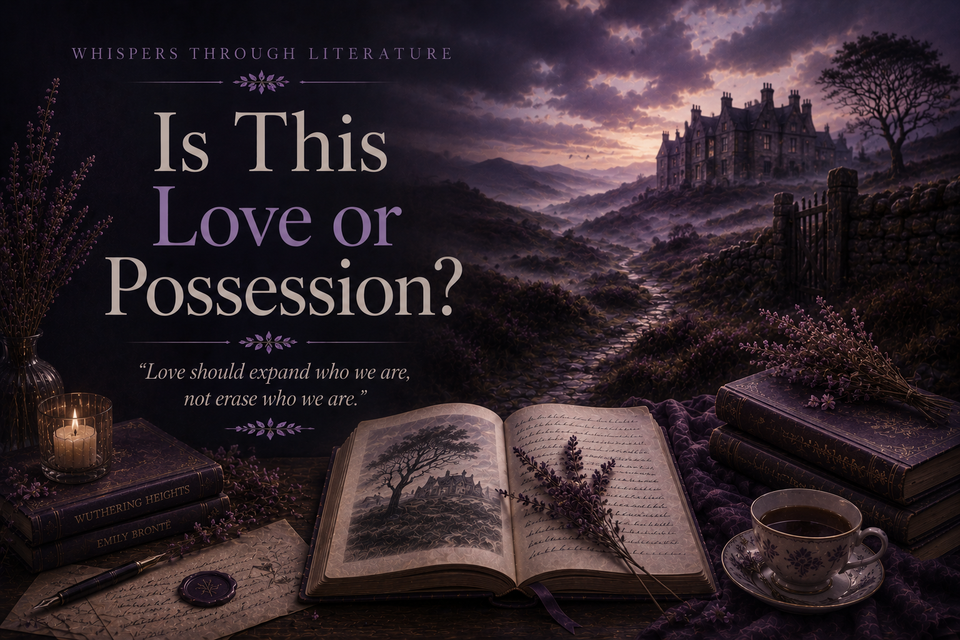
There are few lines in literature as famous as Catherine Earnshaw's declaration:
"I am Heathcliff."
For generations, readers have celebrated those three words as one of the greatest expressions of romantic love ever written. They have become almost synonymous with the idea of soulmates—two people so deeply connected that they can no longer imagine life apart from one another.
And yet, every time I return to Wuthering Heights, I find myself asking a different question.
What if those words are not romantic at all?
What if they are a warning?
That question changes everything.
Because once we begin reading the novel through that lens, we discover that Emily Brontë may not be inviting us to admire Catherine and Heathcliff's relationship nearly as much as she is inviting us to examine it. Suddenly, what once looked like the highest form of love begins to resemble something far more complicated: emotional fusion, identity collapse, and the painful confusion between loving another person and losing ourselves inside them.
One of the most important distinctions this novel asks us to make is surprisingly simple.
Intensity is not the same thing as love.
Human beings are naturally impressed by intensity. We assume that powerful emotions must indicate profound truth. If the longing is overwhelming, surely the love must be extraordinary. If the grief is unbearable, surely the relationship was healthy. If two people cannot live without one another, surely they belong together.
But none of those conclusions necessarily follow.
Fear is intense.
Jealousy is intense.
Anger is intense.
Desperation is intense.
Intensity tells us that something is powerful. It does not tell us whether it is good, healthy, mature, or life-giving.
Perhaps that is why Catherine's famous declaration becomes so unsettling the longer we sit with it.
Healthy love allows two people to become deeply connected while remaining distinct. It creates intimacy without demanding the disappearance of individuality. It makes room for closeness without erasing identity.
Catherine struggles to imagine that distinction.
She does not simply love Heathcliff.
She seems unable to imagine herself apart from him.
And that is a profoundly different thing.
Modern psychology often speaks about differentiation—the ability to remain emotionally connected while still possessing a stable sense of self. Love flourishes when two whole people freely choose one another. But when identity itself becomes dependent upon another person, relationships begin carrying a burden they were never designed to bear.
Perhaps that is why this story feels so contemporary.
Most of us have probably never said, "I am Heathcliff."
But many of us have quietly lived some version of it.
Without this relationship...
Who am I?
Without this dream...
Who am I?
Without this person's approval...
Who am I?
Those questions reveal that attachment has begun to carry the weight of identity.
And that is always too much weight for another human being.
This becomes even clearer when we turn our attention to Heathcliff himself.
Popular culture often remembers him as the great romantic hero of the novel—a man whose love survives rejection, suffering, and even death.
But the novel quietly asks a more difficult question.
If Heathcliff truly loved Catherine, why does he devote so much of his life to destroying what Catherine loved?
One of the most striking examples is his treatment of Cathy.
Cathy mattered deeply to Catherine.
If love genuinely seeks the good of the beloved, then protecting Cathy would have been one of the clearest ways of honoring Catherine's memory.
Instead, Heathcliff repeatedly becomes a source of pain.
That observation forces us to distinguish between two very different realities.
Love protects what the beloved loves.
Possession protects the attachment itself.
Those are not the same thing.
Emily Brontë also refuses to give us easy moral categories.
Heathcliff's suffering is undeniable.
His childhood is marked by rejection, humiliation, abuse, and profound loneliness.
The novel invites us to understand those wounds.
But it never asks us to excuse everything that follows.
And perhaps that is one of its most mature insights.
Trauma explains behavior.
It does not automatically justify behavior.
Compassion and accountability can exist together.
We can acknowledge suffering without surrendering moral responsibility.
Because eventually every wounded person reaches the same question:
What will I do with my pain?
Will I transform it?
Or will I pass it on?
Wuthering Heights is, in many ways, a novel about that very question.
The first generation creates wounds.
The second generation inherits them.
Children grow up inside emotional worlds they did not choose.
They inherit fears, patterns, resentments, and unfinished grief.
Emily Brontë seems remarkably aware that pain rarely remains isolated.
It echoes across families.
Across relationships.
Across generations.
And yet, she refuses despair.
Through Cathy and Hareton, the novel quietly offers another possibility.
Growth.
Not perfection.
Growth.
Their relationship is noticeably different from the one that came before it.
Less dramatic.
Less obsessive.
Less consumed by pride.
More patient.
More humble.
More capable of learning.
That may be one of the most hopeful observations in the entire novel.
Healing rarely begins with flawless people.
It begins when someone chooses differently.
When someone interrupts the pattern instead of repeating it.
As a Christian, I cannot help but notice how beautifully this echoes the spiritual life.
God never asks us to become less ourselves.
He does not love us by consuming our identity.
Grace does not erase individuality.
It perfects it.
Perhaps that is why unhealthy attachment becomes so painful.
It quietly asks another human being to become what only God can be.
Our security.
Our meaning.
Our identity.
Our salvation.
No person can carry that weight forever.
Only God can.
And perhaps that is the deepest lesson hidden beneath Emily Brontë's extraordinary novel.
Love does not consume.
Love does not erase.
Love does not ask another person to disappear so that we can feel whole.
Real love creates room for freedom.
For dignity.
For growth.
For truth.
It allows another person to remain fully themselves while choosing to walk beside us.
Maybe that is why Wuthering Heights still speaks to us nearly two centuries later.
Not because it gives us an ideal romance.
But because it confronts one of the oldest human temptations.
To confuse possession with love.
To confuse intensity with intimacy.
To confuse another person with the answer to the deepest questions of our own identity.
And perhaps the invitation of this story is not simply to recognize those patterns in Catherine and Heathcliff.
Perhaps it is to recognize them, gently and honestly, within ourselves.
Because love should never require us to disappear.
It should help us become more fully who we were created to be.
Reflection Questions
• Have I ever mistaken emotional intensity for genuine love?
• Can I think of a relationship where I confused closeness with losing myself?
• Where is the difference between connection and emotional fusion in my own life?
• Have I ever asked another person to carry a weight that only God can safely hold?
• How has my understanding of love changed as I've matured?
• What unhealthy patterns have I inherited, and which ones do I hope will end with me?
• In what ways is God inviting me to become more fully myself rather than less?
Scripture
Genesis 2:24
"The two shall become one flesh."
A profound image of unity that never erases the individuality of either person.
John 15:12–15
"Love one another as I have loved you."
Christ reveals that authentic love seeks the good of the beloved rather than possession.
1 Corinthians 13:4–8
The characteristics of love remind us that genuine love is patient, generous, truthful, and never self-seeking.
Galatians 5:1
"It is for freedom that Christ has set us free."
Healthy love never enslaves. It leads us toward greater freedom.
Literary & Philosophical Reading
Emily Brontë — Wuthering Heights
Read Catherine's famous declaration, "I am Heathcliff," and ask yourself whether it sounds more like mature intimacy... or identity collapse.
Carl Jung — The Undiscovered Self
On individuation, identity, and the lifelong journey of becoming a whole person.
Erich Fromm — The Art of Loving
A beautiful exploration of love as an act of freedom, responsibility, and maturity rather than emotional dependency.
Saints & Spiritual Reading
St. Augustine — Confessions
On disordered loves, the restless heart, and learning to love created things without asking them to become ultimate.
St. John Paul II — Love and Responsibility
One of the Church's richest reflections on authentic love, self-gift, and the dignity of the human person.
Pope Benedict XVI — Deus Caritas Est (God Is Love)
A profound meditation on the difference between possessive love and love that seeks the good of the other.
Sit With This Question
What if the deepest expression of love is not finding someone I cannot live without... but becoming someone who can love another without either of us disappearing?
Some reflections feel different when they’re heard.

Member discussion