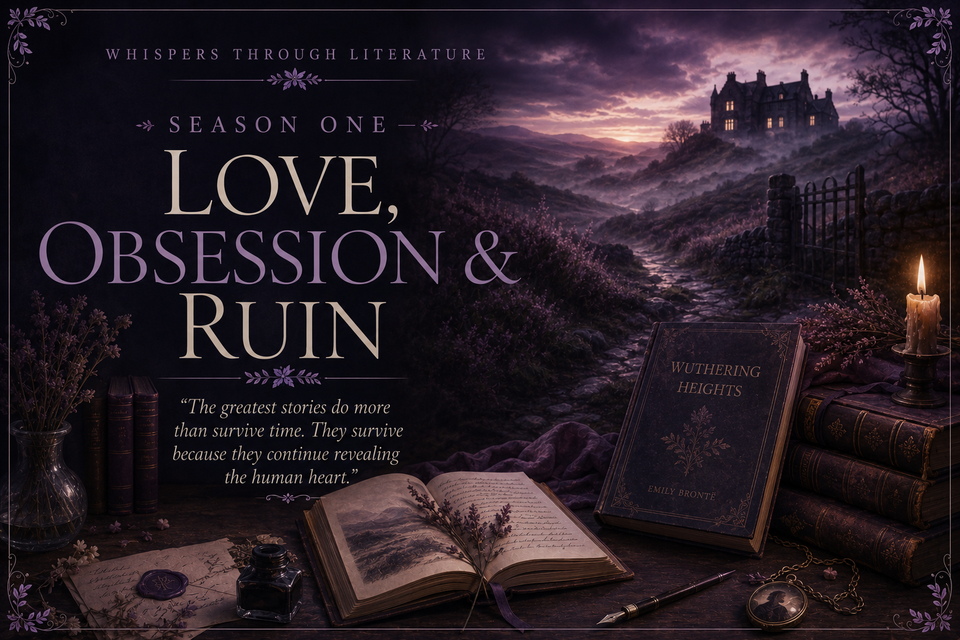
Love, Obsession & Ruin
Before we begin this season, I want to make one thing clear.
This is not a book club.
At least, not in the way most people imagine one.
We are not here simply to summarize chapters, analyze literary techniques, or admire Emily Brontë's remarkable writing—although there will certainly be moments to appreciate all of those things.
What interests me most is something else.
The human soul.
Because I have slowly become convinced that the greatest works of literature endure for a reason.
Not simply because they are beautifully written.
Not because they are historically important.
But because they continue revealing something true about what it means to be human.
And few novels do that as relentlessly as Wuthering Heights.
For generations, readers have approached this novel as one of history's greatest love stories.
Others have called it a tragedy.
Some have described it as a gothic romance.
Others as a psychological masterpiece.
And while I think each of those descriptions captures something real, I also think they leave something important unexplored.
What if this novel is not primarily asking us to admire Catherine and Heathcliff?
What if it is asking us to examine ourselves?
Because beneath every dramatic scene, every betrayal, every act of devotion, every moment of longing, the novel keeps returning to the same questions.
What is love?
What is obsession?
What happens when another person becomes the center of our identity?
Can suffering become part of the way we define ourselves?
Can wounded people create something different from what wounded them?
Can freedom emerge where attachment once ruled?
These are not nineteenth-century questions.
They are human questions.
And perhaps that is why this novel continues to feel so remarkably contemporary.
Our world may look different.
Our technology has changed.
Our vocabulary has changed.
But the human heart continues wrestling with many of the same longings.
We still want to belong.
We still search for meaning.
We still confuse intensity with intimacy.
We still mistake certainty for truth.
We still hope another person might somehow complete what feels unfinished inside us.
And because those questions remain, this story remains.
Throughout this season, we are going to explore Wuthering Heights through several different lenses.
Literature.
Psychology.
Philosophy.
Catholic theology.
Not because every novel secretly teaches Christian doctrine.
It doesn't.
But because every honest story raises questions about the human condition.
And Christianity has spent two thousand years reflecting on many of those same questions.
That conversation is what interests me.
Not proving that Emily Brontë was writing theology.
But asking what her story reveals about attachment, freedom, identity, love, suffering, forgiveness, and ultimately, the restless human heart.
As we move through these episodes, we'll challenge some very familiar assumptions.
We'll ask whether obsession has been mistaken for romance.
Whether chaos has been mistaken for passion.
Whether being understood is the same as being called to build a life together.
Whether longing always points toward the person we think it does.
And whether some of our deepest desires are actually pointing beyond romance altogether.
These are not comfortable questions.
But I think they are worthwhile ones.
Because the best literature rarely leaves us unchanged.
It unsettles us.
Invites us.
Sometimes even confronts us.
Not to shame us.
But to help us see more clearly.
My hope is that by the end of this season, you will certainly understand Wuthering Heights better.
But even more than that, I hope you understand yourself a little better.
Because I don't think the greatest stories exist simply to entertain us.
I think they exist to illuminate us.
And perhaps that is why we continue returning to them generation after generation.
Not because the stories keep changing.
But because we do.
So before we meet Catherine.
Before we meet Heathcliff.
Before we step onto the Yorkshire moors.
Let's begin with a quieter question.
What if this story has been waiting, all along, to reveal something about us?
Welcome to Season One.
Let's begin.
Reflection Questions
• Why do certain novels remain meaningful across generations?
• What stories have quietly shaped the way I understand love, identity, or suffering?
• What assumptions am I bringing into Wuthering Heights before I've even begun?
• Have I ever mistaken emotional intensity for emotional health?
• What do I hope this season will reveal—not only about the novel, but about myself?
• Am I willing to let a story challenge my assumptions rather than simply confirm them?
Scripture
• Matthew 13:10–17
Why Christ taught through stories.
• Proverbs 4:7
"Wisdom is supreme; therefore get wisdom."
• Ecclesiastes 1:9
"There is nothing new under the sun."
• Psalm 139:23–24
"Search me, O God, and know my heart."
Literary & Spiritual Reading
• Emily Brontë — Wuthering Heights
The novel that will accompany us throughout this season.
• C.S. Lewis — An Experiment in Criticism
On why we read literature and how it changes us.
• St. Augustine — Confessions
On the restless human heart and the search for ultimate love.
Sit With This Question
What if the most important thing I discover in this season is not something about Wuthering Heights... but something about my own heart?
♡ Enter Love, Obsession & Ruin
♡ Explore the full series on YouTube

Member discussion