
The Morning of the New Bridge

Porthos had been awake for nearly an hour, which was considerably longer than he thought any respectable dog should be expected to wait for breakfast.
He stood beside the kitchen doorway, his gray Schnauzer beard tilted toward the stove, watching Abbi move between the counter and the table.
“She’s getting the plates,” he announced.
Lenda, who was resting beneath a chair, opened one eye.
“I can see that.”
“That means breakfast.”
“It means plates.”
Porthos considered this objection.
“Plates are usually followed by breakfast.”
Lenda closed her eye again. She had known Porthos for a very long time, and experience had taught her that a conversation about food could continue indefinitely if she encouraged it.
Outside, something large struck the garden door.
Then it struck again.
Theoden had found his ball.
He was a Calupoh: tall, lean, and entirely black, with amber eyes that could look extraordinarily solemn when he wanted someone to play. The solemnity never lasted long.
He stood in the courtyard, tail swinging, looking through the glass with an expression of such tremendous happiness that anyone unfamiliar with him might have wondered what extraordinary event had taken place.
He had found his ball yesterday, too.
And the day before.
From the dining room came the sound of Yaya laughing.
“That dog is going to knock the whole house down one morning.”
“He won’t,” Abbi said, setting a plate on the table. “Although he might persuade you to play ball before you’ve finished your coffee.”
“He already tried,” Yaya said. “Twice.”
“And how many times did you throw it?”
“Twice,” Yaya admitted, with a smile. He moved his cup farther from the edge of the table as another enthusiastic thump sounded from the garden door.
He had been awake since before sunrise, as he was most mornings. There was something about the quiet hours that he loved: the kitchen before anyone came downstairs, the first cup of coffee, the familiar sounds of a house gradually waking.
He had already opened the little garden shed where Porthos sometimes slept, checked the courtyard gate, and taken Theoden for a walk.
Theoden, naturally, behaved as though none of these things had happened and he had been waiting his entire life for someone to take him outside.
When Yaya opened the garden door, the enormous black dog came bounding in.
“Porthos!”
“Theoden!”
They greeted each other with the enthusiasm of two friends reunited after a lengthy separation.
Lenda had just risen from beneath her chair when Theoden’s tail struck her across the face.
She stopped.
“Theoden.”
“Sorry!”
He turned to look at her.
His tail struck her again.
“THEODEN.”
Porthos made a small sound that was unmistakably laughter.
Lenda turned toward him.
He immediately became interested in something near the cupboard.
Theoden lowered his head and gently nudged Lenda’s cheek with his long black muzzle.
She gave him a brief lick on the nose.
“Go on,” she told him.
He did, returning happily to his ball.
Lenda watched him cross the kitchen, then made her careful way toward Abbi. She was the oldest of the three dogs, with a mostly white coat, a proper Schnauzer beard, and a face divided almost neatly between gray and white beneath her expressive eyebrows. There was nothing hurried about her movements, but neither did she appreciate being fussed over merely because she was old.
Abbi bent to scratch her behind the ears.
“There you are, preciosa.”
Lenda leaned into her hand. She liked affection best when she had been the one to request it.
For a moment, the kitchen was peaceful.

Then came the unmistakable sound of two girls talking at once upstairs.
✦ ✦ ✦
Upstairs, Eleonora and Amelia were having a disagreement.
It concerned a ribbon.
More specifically, it concerned whether Amelia had borrowed Eleonora’s ribbon without permission, and whether the fact that Amelia had found it on the floor meant it had been available for borrowing.
“It was on my chair,” Eleonora said.
“It was under your chair.”
“That’s still my chair.”
Amelia, who believed this was an exceptionally weak argument, began explaining the difference between ownership and location.
Eleonora did not find the explanation helpful.
The ribbon was a pale lavender one, with little embroidered flowers along its edges. Eleonora had chosen it because it matched the dress she intended to wear that morning.
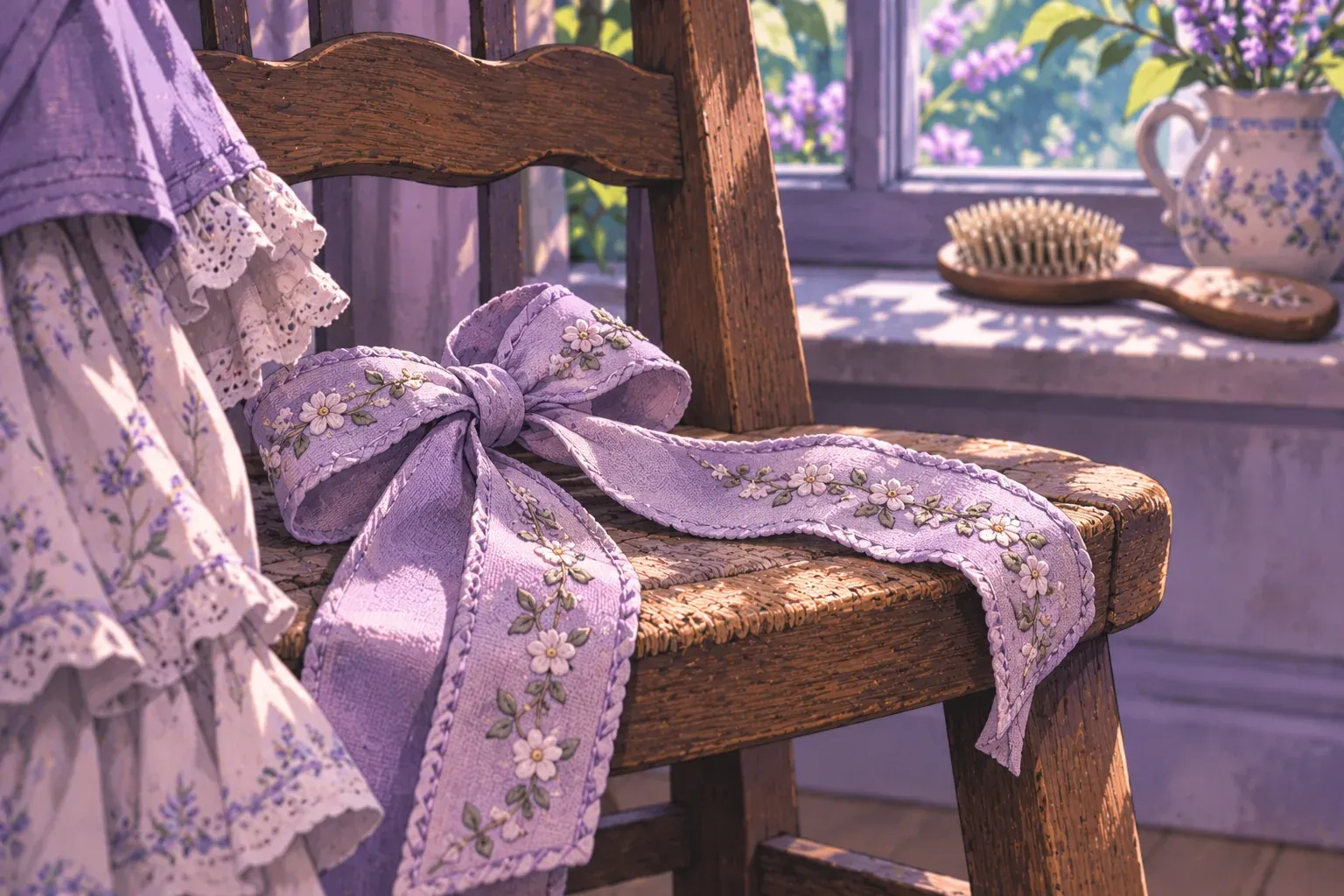
Amelia had chosen it because she liked it.
Therein lay the difficulty.
In the end they agreed that Amelia would choose a different ribbon, although neither sister would have agreed on precisely how the matter was settled.
Eleonora wore the ribbon.
Amelia wore another, which Eleonora had helped her tie. When the second bow kept leaning to one side, Eleonora straightened it, stepped back to inspect her work, and tried again.
“You don’t have to keep fixing it,” Amelia said.
“I know. But I can make it prettier.”
Amelia held still until her sister was satisfied. Then she offered Eleonora the small brush she’d been looking for all morning. It had been on the windowsill, where neither of them had thought to look.
The two of them appeared at the kitchen door with their hair brushed—Eleonora’s dark brown, Amelia’s sandy blonde—and their earlier disagreement apparently forgotten.
Tanina sat at the table with Augustus on her lap.
He had discovered the fastening on Yaya’s old watch and was examining it with great seriousness.
“No, mi amor, that stays on,” Tanina told him gently as his small fingers worked at the clasp.
Augustus looked up at her.
Then he looked back at the watch.
His efforts resumed.
“He’s trying to figure out how it works,” Amelia observed.
“I know,” Tanina said. “And that’s wonderful. But he doesn’t need to take it apart to find out.”
Yaya laughed.
“Let him. Maybe he’ll fix it.”
“There’s nothing wrong with it, Yaya,” Abbi replied.
“Exactly. He can make sure.”
Augustus, who had no particular interest in the discussion, reached for the watch again.
Tanina turned the watch over once so he could see the fastening open and close. He watched closely, then looked up at her as if to ask why he wasn’t being permitted to attempt the operation himself.
“You may watch,” she said. “This one belongs to Yaya.”
She offered him a small wooden toy that could be opened and closed without doing permanent damage to anyone’s belongings. He accepted the exchange after a moment’s consideration, then worked the wooden latch with the concentration of a clockmaker.
Eleonora leaned over and kissed his brown curls.
“Good morning, Augustus.”
He smiled at her, then held up his toy.
“Look!” she said. “What have you got?”
Augustus demonstrated the mechanism.
Amelia came closer to inspect it, but he drew it protectively toward himself.
“All right,” she said. “You can show me later.”
He considered this arrangement satisfactory.
Breakfast began once everyone was seated. Abbi made sure the children had what they needed, and Yaya offered the morning prayer. Augustus attempted to join the final Amen, producing something that pleased his grandparents enormously.
Afterward, Abbi passed the bread to the girls and reminded Amelia that she had promised to return a borrowed book. Amelia had packed it the night before, although she went to check anyway.
“There’s a new book on the upper gallery that I want to see,” she announced when she came back.
“You said that last Saturday,” Eleonora told her.
“It was being repaired last Saturday.”
“Then I hope it’s finished,” Abbi said. “And remember, if the librarian has set it aside, she may have a reason. Ask before you take it.”
Amelia agreed readily. The library’s rules were familiar to her, and she appreciated that they helped keep the older books in good condition.
Eleonora had her own plans. She wanted to return an illustrated storybook she’d borrowed twice already, though she hoped Señora Malva would let her look at it for a few minutes first. There was a painting inside of a garden wall in five different shades of purple, and she had not finished deciding which shade she liked best.
The conversation moved from books to the plans for the day.
There would be activity in the village square. The proposed new bridge was to be presented to the community, and several merchants had arranged stalls for the occasion.
“We can visit the library before we see the bridge plans,” Abbi told them. “There’s plenty of time.”
“And then the bridge?” Amelia asked.
“If the weather holds,” Yaya said. “We can walk down to the meadow and see the old crossing from the path. I want to have a proper look at the plans first.”
“Can the dogs come?” Eleonora asked.
At the word dogs, Theoden lifted his head.
“Yes,” Yaya answered. “Provided everyone stays together.”
“Excellent,” Porthos said.
“You don’t know what they’re talking about,” Lenda pointed out.
“They said dogs.”
“That doesn’t mean food.”
“I didn’t say it meant food.”
Lenda looked at him.
Porthos waited.
“Although,” he added, “there may be food.”
✦ ✦ ✦
Little Hearts Village was particularly lovely in the morning.
The houses stood close together along gently winding streets, most built of pale stone or warm plaster, their roofs weathered by countless seasons of rain and sun. From the outskirts, the village appeared to nestle between low fields and the great wooded hills beyond them. From within its streets, those hills were easy to forget; there were always windows to open, people to greet, and a hundred small things happening at once.
Few of the houses were grand. Some had crooked doorframes, narrow staircases, or shutters that no longer closed quite evenly. One house near the bakery had a climbing vine that appeared determined to reach the roof before the end of summer.
But almost everywhere, in one way or another, there was purple.
Lilac shutters opened above flower boxes. Soft violet doors stood beneath stone arches. Lavender grew in clay pots along windowsills, and wisteria hung from the balconies of older houses.
Even the shadows seemed to carry a faint bluish-purple hue when the sunlight fell across the cobbled streets.
Not everything was purple, of course. The market awnings were cream and sage green, the church was built of pale honey-colored stone, and the oldest houses had dark wooden doors polished by generations of hands.
The purple belonged to the village in the way a favorite melody belongs to a family. Nobody needed to explain it.
A seamstress had hung violet ribbons outside her shop to dry. Across the lane, a carpenter was carrying a freshly painted lavender shutter beneath one arm, while his apprentice tried to persuade him that the paint had dried. At a window above them, somebody shook out a pale lilac tablecloth and called an apology to the man below.
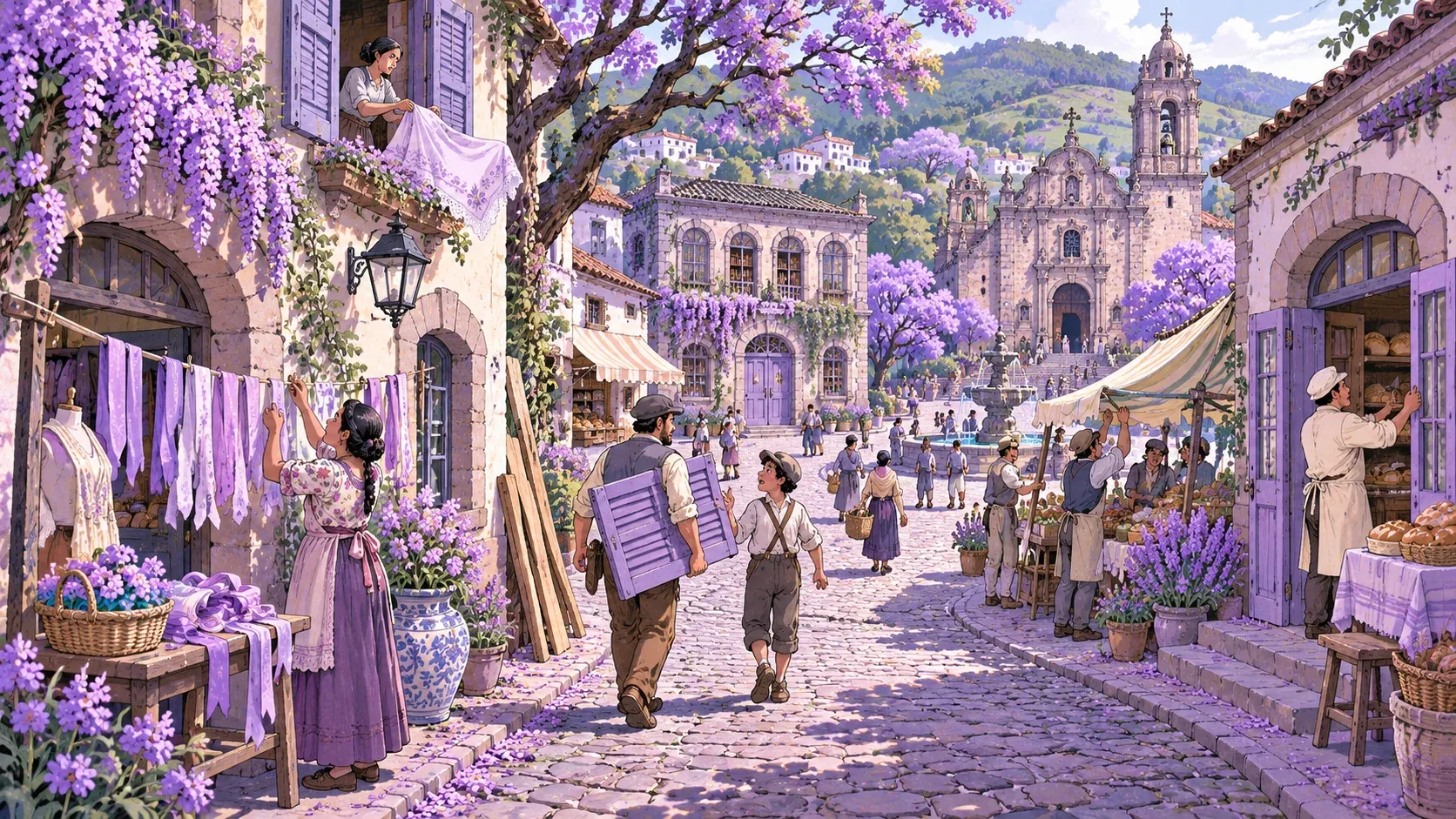
By the time the family reached the square, the bakery windows were open and the bell above the church door had begun to ring.
At the center stood the church, its bell tower visible from almost every street. Beside it spread the main square, with a fountain, a collection of shops, and a broad paved area where villagers gathered for celebrations, processions, and ordinary conversations that sometimes lasted much longer than intended.
The bakery occupied one corner of the square.
The library stood across from it.
And if Amelia had been asked which was more important to the village, she would have answered without hesitation.
The library.
Porthos would have disagreed.
✦ ✦ ✦
The village library occupied an old two-story building with arched windows and a heavy wooden door painted a soft, dusty violet.
Above the entrance, carved into the stone, were the words:
THE LITTLE HEARTS LIBRARY

Inside, the air smelled of paper, polished wood, and the faint sweetness of flowers growing just outside the windows.
Bookshelves lined the walls from floor to ceiling. A narrow gallery ran along the upper level, reached by a winding staircase that had been fitted with a sturdy railing many years earlier.
There were long tables for studying, smaller ones for children, and comfortable chairs near the windows.
At the back was a little reading room overlooking a courtyard garden. On clear days, sunlight passed through the leaves and made moving patterns across the floor.
Eleonora loved that room.
Amelia loved almost every room.
The girls had been visiting the library for as long as they could remember. They knew which floorboards creaked, which window caught the afternoon sun, and which shelves held the books they were most likely to borrow. They also knew that the third stair gave a faint squeak, that the chair beside the garden window had a loose cushion, and that it was useless to arrive after lunch expecting to find their favorite reading alcove empty.
They had a private understanding about that alcove. If Amelia arrived first and Eleonora wanted to draw, Amelia made room for her. If Eleonora was there with her sketchbook and Amelia found a story too interesting to put down, Eleonora shifted her pencils and made room in return. On particularly good afternoons they could stay there together without saying a word, something neither sister managed nearly so well at home.
Sometimes they came with Abbi. Sometimes with Yaya. Sometimes Tanina brought them and spent an hour reading nearby while they explored the shelves.
They came even when they had nothing to look up, and often left with more books than they had planned to borrow.
“Good morning, girls!”
Señora Malva looked up from the desk near the entrance.
She was sorting a small stack of returned books, occasionally stopping to examine a worn binding or straighten a page. A tiny pot of lavender stood beside her ink stamp, and her spectacles hung on a cord around her neck. She had a habit of remembering not only what people borrowed, but what they said about it when they brought it back.
“Good morning!” Eleonora replied.
Amelia had already begun looking toward the staircase.
“Before you disappear,” Señora Malva said, smiling, “I have something for you. But first, Amelia, did you finish the book about the mountain travelers?”
“Yes. The last chapter was much too short.”
“I thought you might say so. And Eleonora?”
“I liked the pictures, but the girl in the story never listened to anybody.”
“A difficult quality in a traveling companion,” Señora Malva observed. “Let’s see whether these suit you better.”
She reached beneath the desk and brought out two books.
One was a beautifully illustrated collection of stories about gardens, travelers, and forgotten places. Its cover was decorated with delicate painted leaves.
Eleonora immediately reached for it.
The other was a thick volume containing accounts of inventions, expeditions, and remarkable discoveries.
“There’s a section on old bridges,” Señora Malva added. “I thought you might like it, with all the talk about the new crossing.”
Amelia took it with both hands.
“Are these new?”
“New to our collection,” Señora Malva explained. “The books themselves are rather older.”
Amelia opened hers.
“Look at this! There’s an entire chapter about how people used to build things without modern machinery.”
Eleonora examined the illustrations in her own book.
“And look at these flowers.”
“That’s a drawing,” Amelia said.
“I know it’s a drawing.”
“I mean, those flowers aren’t necessarily real.”
“They’re still beautiful.”
Amelia considered that.
“Yes, they are.”
They bent together over the books, each trying to show the other a page.
They carried the books to their familiar alcove, where a younger child was already sitting with a picture book opened across both knees. Eleonora paused in the doorway. Her pencils would fit perfectly on the little table, but there was no room for all of them to sit comfortably.
“We can use the long table,” she whispered to Amelia.
“I don’t mind,” Amelia said. “The light’s better there anyway.”
It wasn’t, particularly. Eleonora knew that, and she gave her sister a grateful look.
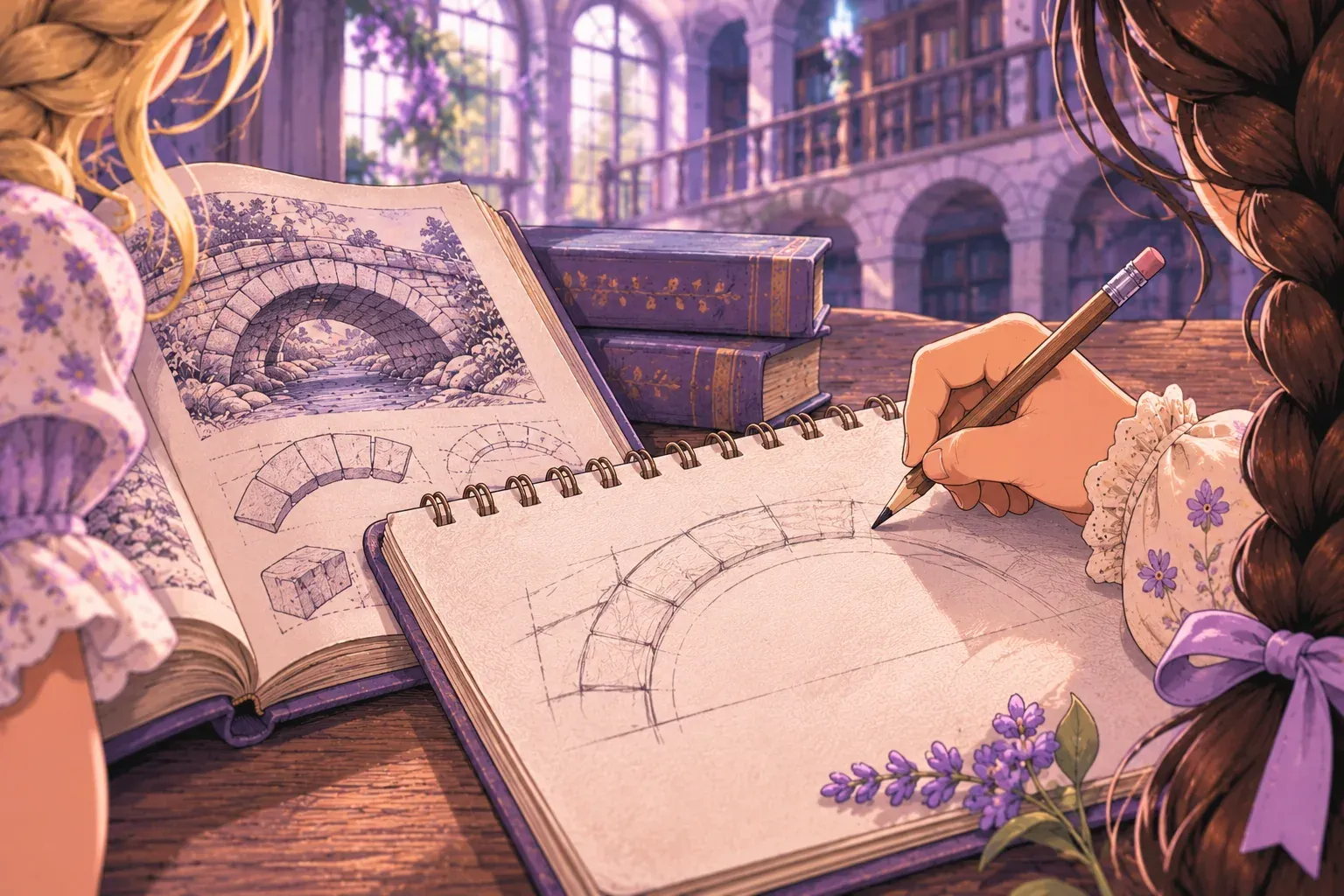
At the long table they opened their books side by side. Amelia immediately began asking how an old stone arch could hold so much weight. Eleonora traced a curving line in the air above an illustration without touching the paper. After a while, neither girl remembered to be disappointed about the alcove.

Abbi smiled when she saw them settle, then spoke with Señora Malva about a damaged book that needed repairing. She offered to help prepare the cloth for its new cover, if Señora Malva would show her which material was suitable. The librarian promised to set aside the necessary supplies; they had repaired books together before, and Señora Malva trusted Abbi’s steady hands with the older volumes.
Tanina settled near the children’s reading area with Augustus, who was fascinated by a board book containing pictures of farm animals.
He turned the pages carefully, then pointed to a goat.
“Goat,” Tanina told him.
Augustus looked at her.
“Goat.”
He pointed again.
“Yes. That’s a goat.”
The picture apparently required further examination.
Across the room, Amelia had found a passage in her book that she wanted Eleonora to hear.
“Did you know that some old bridges were built without using any metal at all?”
Eleonora looked up.
“How did they stay together?”
“That’s what I’m reading. They shaped the stones so the weight pressed inward instead of making everything fall apart. Look.”
Amelia tilted the book so her sister could see the drawing of an old arch.
“That one’s beautiful,” Eleonora said. “The stones look like they’re holding hands.”
Amelia looked again. It was not the explanation given in the book, but she could see what Eleonora meant.
“Not exactly hands,” she said. “But they do hold one another in place.”
Eleonora took out her sketchbook and tried the curve on a blank page. Amelia bent over the text, determined to understand how the builders had known where to put each stone.
Yaya waited outside beneath a tree by the library courtyard. Theoden had settled at his feet, one enormous paw resting on the ball. Lenda lay nearby, where the paving stones were warm.
Porthos watched the people passing through the square. He liked company, and company was especially agreeable when it noticed him.
A small girl came hurrying out of the library with her father. One of her knitted mittens fell from her coat pocket and landed beside the steps. Neither of them noticed.
Porthos did.
“She’s dropped something,” he said.
Theoden lifted his head. “What?”
Porthos gave a brisk bark. Yaya looked around, followed his gaze, and saw the mitten lying on the pavement.
“Good eye, compañero.” He picked it up and called after the pair.
The child ran back, smiling when Yaya handed it to her. She crouched to stroke Porthos’s beard, and he accepted her thanks with obvious pleasure. His tail beat against the stones until she rejoined her father.
“She was going to lose that,” he told Theoden.
“She nearly did.”
“And then her hand would have been cold.”
Lenda looked toward the bright morning sun but didn’t disagree.
A few minutes later, Tanina came out with Augustus in her arms. She paused beside Yaya and asked whether the dogs had been behaving.
“Perfectly,” Yaya said. “Porthos even helped somebody.”
“Of course he did.” Tanina scratched Porthos between the ears before returning inside to collect the girls and Abbi.
Porthos watched her go, rather pleased with his morning.
✦ ✦ ✦
By the time they reached the square, a considerable crowd had gathered around the bridge plans.
Two large drawings had been mounted on a wooden display board. The first showed the old crossing, where a narrow bridge spanned the stream just before the trees began. The second showed a new footbridge farther downstream, beyond a bend near the orchards. The banks were higher there, and the new path would rejoin the road on the other side without passing through the old approach.
The replacement was wider, with firm railings and a gently rising walkway. On the drawings, the old bridge was marked for removal once the new crossing opened.
Yaya studied the plans carefully.
“They’ve chosen higher ground,” he said, pointing to the bend. “That’s sensible. The water rises quickly after a storm.”
Abbi leaned closer.
“And there’s room for people to cross side by side. That will be much easier for families.”
“Especially with our little caballerito,” Yaya said, looking toward Augustus, who had become fascinated by a loose button on his grandfather’s shirt.
Tanina gently redirected her son’s fingers.
“I think Augustus is more interested in taking your shirt apart.”
“Well, somebody has to inspect the construction,” Yaya replied.
Abbi laughed.
“He can inspect the bridge when it’s finished.”
Yaya looked down at Augustus.
“You hear that, compañero? We’ve been promoted.”
Augustus smiled, although he had no idea what he’d just been promoted to.
Nearby, a young shopkeeper was speaking with the Keeper, the gentleman who had offered to contribute much of the money for the new crossing.
The Keeper was an elderly man, tall despite his years, with neatly combed silver hair and a dark waistcoat that had been carefully brushed. His walking stick was hooked over one arm, leaving both hands free to hold a set of plans while he listened.
“If they close the lane by the orchard, my delivery cart won’t get through,” the shopkeeper was saying.
“Then we’ll need a different arrangement,” the Keeper replied. “The new bridge should make things easier, not put you out of business. Tell me which mornings your deliveries arrive.”
The shopkeeper explained, and the Keeper made a note in the margin of his plans. He promised to raise the matter with the council’s engineer before the work began.
As the young man left, a woman with a basket stopped to ask whether the carpenter he’d recommended could still help with her father’s roof. The Keeper remembered the trouble immediately and said he would speak to the carpenter that afternoon.
He had been involved in village affairs for decades. His family owned several buildings near the square, and he had contributed to repairs after storms, to the library’s new windows, and to improvements the public budget could not cover. On a busy morning, he was rarely allowed to finish one conversation before another began.
“Yaya!” he called when he noticed the family approaching.
The two men greeted one another warmly.
“Come and have a look,” the Keeper said. “I’m glad they found a better site for the foundations.”
“I was just telling Abbi that the higher banks look much safer.”
“That’s what the engineers recommended. The council agreed, and we’re trying to make the change as smooth as we can for everyone.”
He turned toward Abbi.
“And how is everyone?”
“Very well, thank you. The girls are especially excited about the library’s new books.”
“Ah, the library.”
For a moment, his expression softened.
“I’m pleased to hear it’s being used so much.”
“Used?” Amelia said, joining them. “We’re practically there every day.”
“An excellent habit.”
He looked at the book beneath her arm.
“What are you reading?”
She showed him the cover.
“Discoveries and inventions.”
“An ambitious subject.”
“It’s very interesting.”
“I’m sure it is.”
He seemed genuinely amused by her enthusiasm.
Then he turned to Eleonora, who was holding her illustrated book against her chest.
“And what have you chosen?”
“Stories about gardens. This one has lovely pictures.”
“Then I hope you find one you want to draw.”
Eleonora smiled.
He stopped to hear Amelia explain why a stone arch could bear its own weight. Before she had quite finished, Señora Mora approached from the next stall with a folded note.
He excused himself politely.
“Forgive me. I promised to speak with Señora Mora about the market stalls.”
Before leaving, he bent slightly toward Augustus.
“And who is this fine young gentleman?”
Augustus studied him solemnly.
The Keeper offered his hand.
After a moment, Augustus touched one finger.
“A pleasure,” the old man said.
Then he moved on.
Eleonora watched him speak with Señora Mora, who had been worried about where her stall would go once the bridge work began. She seemed relieved by whatever arrangement they reached.
“He’s very nice,” Eleonora said.
“He has been generous with this village,” Yaya replied. “And he takes the trouble to listen. That’s worth a great deal.”
“He asked about our books,” Amelia said.
“He did,” Yaya agreed, and they continued toward the other stalls.
✦ ✦ ✦
The square grew busier as the morning passed.
At one stall, Señora Mora was arranging jars of honey. At another, a merchant displayed small wooden toys made by a craftsman who lived beyond the church.
Children hurried between their parents, and a group of older boys had gathered beside the fountain to discuss the bridge’s proposed construction.
The church bells sounded, and several people paused briefly before continuing their conversations.
Near the edge of the square, a thin elderly gentleman emerged from a narrow street carrying a small parcel beneath one arm.
He wore a well-worn coat with a patched cuff and walked at an unhurried pace, keeping close to the buildings where the sunlight fell in narrow strips.
“There’s Mr. Plumnoir,” Amelia observed.
Eleonora glanced over.
Mr. Plumnoir lived in a house beyond the western edge of the village, where the buildings grew fewer and the streets gave way to gardens and fields.
He seldom stayed long in the square, and the girls knew little about him beyond the route he usually took home.
That morning, he stopped briefly at a stall, purchased something, and continued on his way.
He acknowledged Abbi’s greeting with a slight movement of his head.
Abbi returned the courtesy and went back to speaking with Tanina.
Porthos, who remembered once barking at Mr. Plumnoir without receiving so much as a proper greeting in return, watched him cross the street.
“There’s that fellow again.”
“He hasn’t bothered you,” Lenda said.
“I didn’t say he had.”
Mr. Plumnoir turned the corner and disappeared from view.
Porthos returned his attention to the market.
There were more interesting things to consider.
For example, the bakery.
Its door stood open, and just inside, on a low wooden tray, lay six golden rolls.
“Well,” Porthos said softly, “that’s unfortunate.”
Lenda looked up.
“What is?”
“Someone has left the bread unattended.”
“The baker is standing right there.”
Porthos watched the baker turn toward a customer.
“Not anymore.”
He took one step.
“Porthos.”
Tanina’s voice came from behind him.
He stopped.
She hadn’t raised her voice, but there was something about the way she said his name that suggested the discussion was already finished.
Porthos sat down.
“I was only looking,” he informed Lenda.
“Of course.”
Tanina went back to speaking with Abbi, a faint smile lingering on her face.
✦ ✦ ✦
Before noon, the family began walking toward the meadow beyond the last houses. The square was behind them now, its voices growing fainter with every turn. Ahead, the lane narrowed beside low stone walls and small gardens, and the air grew cooler where the stream passed under a stand of trees.
The path was familiar to Yaya. He had taken the girls there many times when they were younger, and he still enjoyed walking along the stream whenever the weather permitted.
The old bridge stood where the meadow narrowed and the stream curved toward the woodland. The familiar walking path followed the near bank. Across the water, undergrowth pressed against the bridge’s far approach so thickly that it was difficult to imagine where the old road had gone.
Farther downstream, beyond the bend, a line of fresh survey stakes showed where the replacement would cross. That route led toward the orchards and the traveled road beyond them, away from the trees.
At the old bridge, the forest rose close and dense on the far bank, its taller trees crowded together behind the smaller ones.
The woodland had always been part of the landscape around Little Hearts Village. People gathered fallen branches along its accessible edges, walked its nearer paths, and sometimes ventured farther with proper preparation.
But the deepest forest was another matter.
Few villagers had any reason to travel there.
The old tracks were difficult to follow, and much of the land beyond the familiar paths had long since been reclaimed by trees and undergrowth.
Eleonora liked the way sunlight fell across the meadow. She had brought a little sketchbook in her bag, hoping she might find something worth drawing.
Amelia was still thinking about the book she had borrowed.
“Yaya, how old do you think the original bridge is?”
“The one that’s there now? I’m not certain. Parts of it have been repaired several times.”
“Could the foundations be older?”
“Possibly. People have used this crossing for a very long time.”
“How long?”
Yaya smiled.
“That is an excellent question.”
Amelia waited.
He laughed gently.
“And one I don’t know the answer to.”
She looked toward the stream.
“I wonder if the library has anything about it.”
“It very well might.”
Eleonora took out her sketchbook.
“Maybe we could draw the old bridge before they take it down. Not just the bridge—how the trees look behind it.”
“I’d like to see that,” Abbi said. “It’s a view we’ve known for years.”
“Could we ask someone whether the drawings might go in the library?” Eleonora wondered.
“You could,” said Yaya. “But first you’d have to make them. And then you’d have to ask the librarian what she thought.”
Eleonora opened to a clean page. She began with the line of the stream, trying to capture the way it turned before reaching the bridge.
Tanina adjusted Augustus in his stroller. The little boy had begun to grow sleepy, although he was still trying to watch everything around him.
“We’ll stay on this side,” she reminded the girls. “The bridge isn’t safe to cross, and the workers have closed it off.”
“We know,” Eleonora answered.
“I know you do. I’m reminding you.”
Both girls remained beside the adults.
The old bridge was visible ahead, beyond a section of low fencing that had been placed along the approach. Its wooden boards were faded, and one side leaned slightly where the supports had shifted.
Two workers were measuring the old approaches before the bridge’s eventual removal. Their cart stood on the meadow side of the stream, loaded with measuring rods, stakes, and boards for reinforcing the temporary fence. The new crossing would not be built until the following week; a notice on the near-bank path explained that the old bridge would remain closed throughout the work.
Yaya asked whether the family was standing clear of the survey area. One of the workers showed him the boundary stakes and thanked him for checking. They kept to the open meadow, well away from the fenced bridge.
Theoden lay down in the grass, content to watch the activity.
Lenda remained near Abbi.
Porthos wandered a few steps farther along the path, sniffing enthusiastically at a patch of clover.
Then he heard a voice.
“Excuse me.”
He looked around.
A small brown-and-white goat stood near a fence beside the meadow.
Her owner, a woman who sold cheese and fresh milk at the market, had brought Canela out to graze while she checked a fence on the neighboring field. The goat’s rope was fastened to a wooden post some distance from the workers, and she was occupied in examining the leaves growing just beyond her reach.
“Are you speaking to me?” Porthos asked.
“Unless there’s another gray dog standing in front of me.”
Porthos straightened.
“I am Porthos.”
“I know.”
“You do?”
“You introduced yourself last week.”
Porthos thought about this.
“Oh. Yes.”
The goat returned to her leaves.
Her name was Canela.
She was well known around the village, partly because she was an affectionate and generally agreeable creature, and partly because she had a remarkable ability to find herself in places where she had not been invited.
Her owner had once discovered her standing inside a neighbor’s kitchen.
Canela maintained that the kitchen door had been open.
She saw no reason to discuss the matter further.
“Have you had breakfast?” Porthos asked.
“Yes.”
“A proper breakfast?”
Canela looked at him.
“Is there another kind?”
Before Porthos could explain, a sharp clatter sounded behind them.
One of the workers was lifting a board from the cart when its end slid from his grip. It struck the wooden side with a tremendous crack.
The noise was louder than anyone expected.
Canela startled. She sprang backward, and the rope snapped tight. The loop had been resting over the top of a weathered post; the sudden pull lifted it clear.
For one moment, she stood completely still.
Then she ran.
“Canela!” Porthos shouted.
The goat bounded across the grass, dragging the rope behind her.
Her owner, who had just returned from speaking with one of the workers, turned in alarm.
“Canela! Come back!”
The goat did not come back.
She ran toward the trees.
Theoden sprang to his feet.
“Where is she going?”
“I don’t think she knows!” Porthos replied.
Lenda remained beside Abbi, ears sharply forward. She knew better than to join a chase simply because the others had started one.
“Don’t crowd her,” she called to the others. “You’ll frighten her more.”
Theoden slowed immediately.
Porthos attempted to slow, too, although his small legs continued carrying him forward for another few steps.
“Canela!” he called again. “You’re going the wrong way!”
“I’M GOING AWAY FROM THE NOISE!”
“Yes, but—”
“I KNOW WHERE I’M GOING!”
Porthos looked toward the trees.
He was not convinced.
Behind them, Yaya had turned from the workers.
“What happened?”
“Her rope came loose,” the woman explained anxiously. “She was frightened by the noise.”
Tanina took hold of the stroller.
“Girls, stay here with Abbi.”
Eleonora closed her sketchbook.
“Can we help?”
“You can help by staying together until we know where she’s gone.”
Yaya was already studying the edge of the meadow.
“The ground is firm on this side, but there’s tangled brush beyond those shrubs,” he said. “Let’s find where she’s stopped before anyone goes after her.”
He asked Canela’s owner to keep calling from the meadow, where the goat would recognize her voice, and made sure the children remained with Abbi and Tanina before looking toward the shrubs.
He looked toward the dogs.
“Theoden. Here.”
The great black dog returned at once.
Porthos hesitated.
Canela’s voice had disappeared among the trees, and he could hear movement in the undergrowth.
“Porthos,” Yaya called.
Porthos came back reluctantly.
Lenda stood nearby, watching the place where the goat had vanished.
Her ears twitched.
There was another sound from the trees.
A bleat.
Then the rattle of branches.
Canela was still moving.
Eleonora looked toward the woodland.
Beyond the meadow, the trees grew close together, their roots twisting through the earth beneath a deep carpet of leaves.
She had walked along this path many times, but usually she had been looking at the stream, the wildflowers, or the changing colors of the hillside.
Now she noticed a line in the earth between two trees. Fallen leaves filled a shallow depression that ran straighter than the slopes around it. Near its edge, just visible beneath the ivy, was the pale corner of a stone.
She couldn’t make out what it was from the meadow, and she stayed where Tanina had asked her to stay.
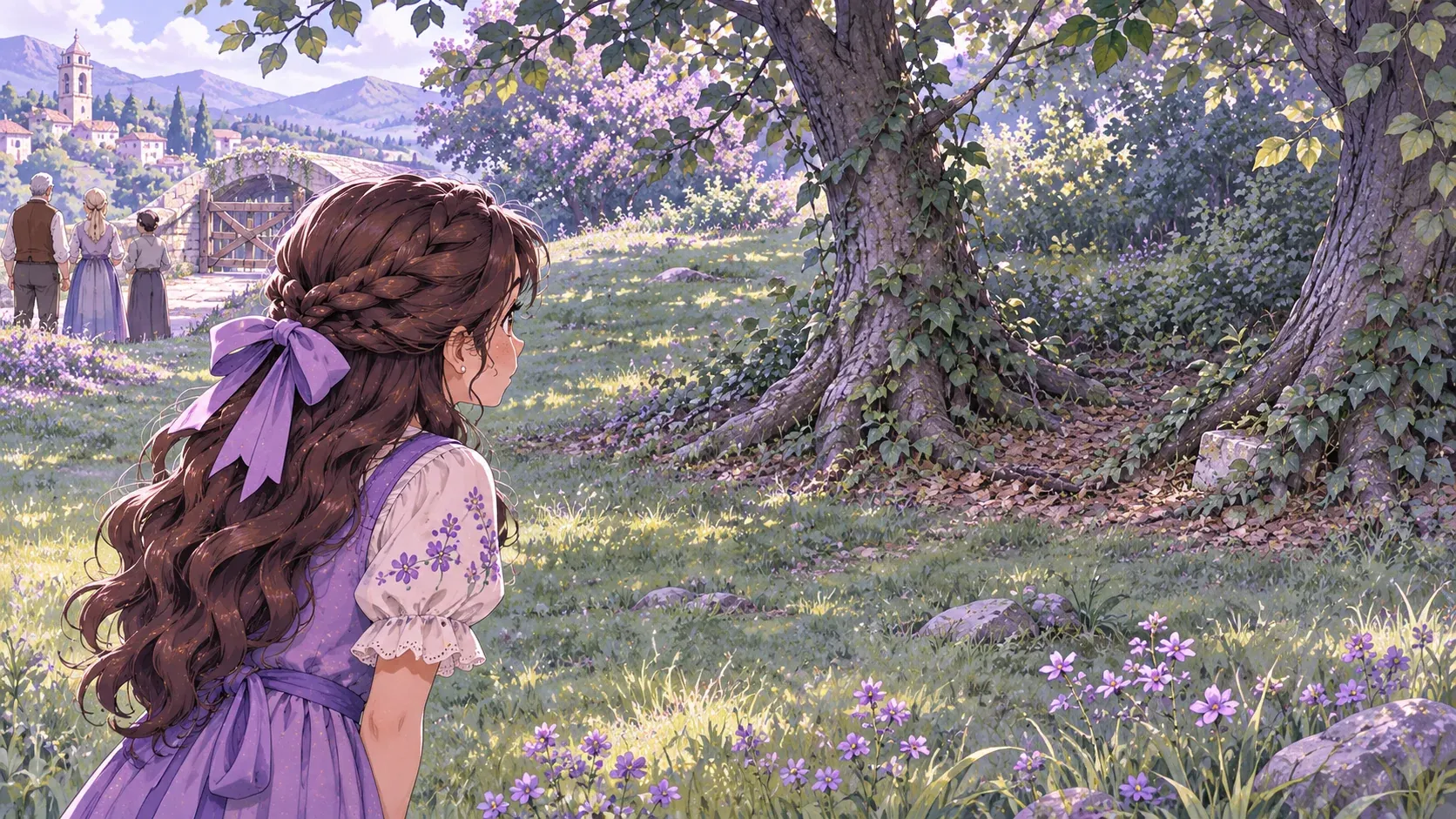
Before she could examine it more closely, another bleat sounded.
This one was much louder.
And much less confident.
“Oh, dear,” Lenda said quietly.
Porthos turned toward her.
“What?”
Lenda was listening.
Somewhere beyond the shrubs, Canela called again.
“I think,” Lenda said, “she’s stuck.”
Canela bleated again. Something scraped against stone beneath the leaves.
Eleonora looked toward the pale corner she had noticed between the roots. The sound seemed to come from just beyond it.
Yaya approached the first line of shrubs, staying on the open ground, and called to the goat.
There was an indignant answer. Then the rope creaked, pulled tight against something none of them could see.

Member discussion