
When God Permits What He Does Not Desire
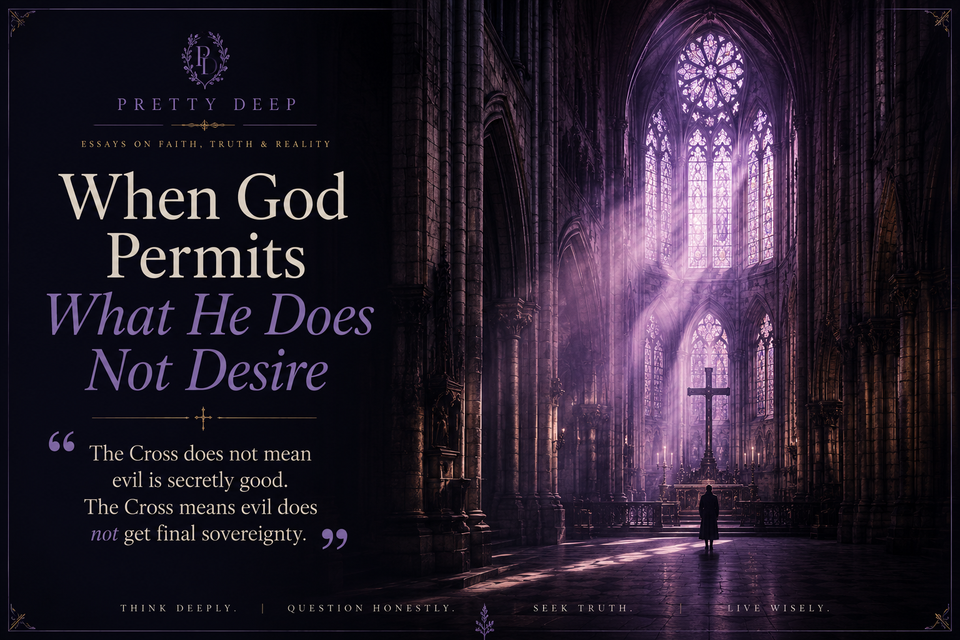
A Catholic reflection on providence, freedom, moral evil, and the God who enters suffering.
Some questions deserve more than slogans.
Especially when they involve suffering.
Especially when they involve history.
Especially when they involve God.
This reflection is a deeper companion to Did God Want It to Happen?—not because that conversation was incomplete, but because some questions deserve a slower, more rigorous, more honest exploration.
If God is sovereign, what does it actually mean for Him to permit moral evil?
That is where we begin.
The Real Question
Some questions deserve more than quick answers.
This is one of them.
And honestly, I think one of the first mistakes we make in conversations like this is asking the wrong question altogether.
The question people often ask is:
Why do bad things happen?
And while I understand that question emotionally, it is actually too broad to be very helpful.
Because what do we even mean by bad things?
Illness?
Natural disasters?
Loss?
Broken relationships?
Personal disappointment?
War?
Betrayal?
Murder?
Spiritual dryness?
The problem is that Christianity does not approach all forms of suffering through exactly the same lens.
A hurricane is not the same category as betrayal.
Cancer is not the same category as cruelty.
A fallen world is not the same thing as deliberate moral evil.
And if we fail to make those distinctions, we end up asking vague questions—and vague theology rarely comforts anyone for long.
Especially when suffering is real.
So I think we need to ask something sharper.
Something more honest.
Not:
Why do bad things happen?
But:
If God is sovereign, why does He permit moral evil?
That is a very different question.
Because now we are not talking about generic suffering.
We are talking about the kinds of wounds that emerge from human choice.
Cruelty.
Violence.
Abuse.
Betrayal.
Oppression.
Historical atrocity.
The kinds of things that make the human heart recoil and say:
This should not be.
And once the question is framed that way, the emotional pressure becomes much harder to avoid.
Because if God is truly sovereign—not in some vague poetic sense, but genuinely sovereign—then intervention is possible.
Which means the uncomfortable question immediately follows:
If God could stop moral evil… why doesn’t He always?
That is not a rebellious question.
It is not a faithless question.
And I think Christians sometimes become unnecessarily nervous around questions like this, as though asking them somehow reflects spiritual weakness.
I don’t think that’s true at all.
In fact, I think the opposite.
Some questions emerge precisely because we take goodness seriously.
Because we believe justice matters.
Because suffering matters.
Because human dignity matters.
The grieving person is not asking an abstract philosophical puzzle.
The victim of cruelty is not engaging in intellectual entertainment.
These are deeply human questions.
And if Christianity is going to say anything meaningful here, it has to be emotionally honest enough not to rush past that.
Because the human heart has always asked some version of the same question:
If God is good… why this?
That question is ancient.
And sacred, in its own way.
Not because suffering is holy.
But because honest wrestling often is.
And if we are going to approach this seriously—not sentimentally, not defensively, but seriously—then we need clarity before comfort.
Because one of the most dangerous things theology can do is offer emotional certainty at the expense of truth.
So before we say anything else, we need to begin here:
with the real question.
The Fatalism Mistake
One of the most damaging ideas Christians sometimes absorb—often without even realizing it—is the belief that if God is sovereign, then everything that happens must be exactly what He wanted.
You’ve probably heard versions of this.
Maybe you’ve even said them before.
Everything happens for a reason.
It was all part of God’s plan.
If God allowed it, He must have wanted it.
And I understand why phrases like that can feel comforting.
Especially when life feels chaotic.
There is something emotionally reassuring about believing everything is perfectly scripted, even the painful parts.
Because certainty can feel safer than ambiguity.
But comfort and truth are not always the same thing.
And this is where I think Christians need to be very careful.
Because if we follow that logic honestly, it creates serious moral problems very quickly.
If everything that happens is equally and positively willed by God in exactly the same sense… then what do we do with cruelty?
What do we do with abuse?
With betrayal?
With genocide?
With violence?
Do we really want to say those things were directly desired by God in the same way goodness is?
Because if we do, we have created a theological problem far bigger than the one we were trying to solve.
At that point, God starts to sound less like a holy and good Creator…
and more like a cosmic architect scripting suffering for reasons we are simply told not to question.
And honestly?
That is not the God Christianity presents.
This is where distinctions matter.
And not because distinctions are academic exercises for people who enjoy theological vocabulary.
They matter because bad theology eventually lands on real human hearts.
If we are careless here, wounded people begin to believe horrifying things.
That their suffering was assigned.
That abuse was somehow spiritually intended.
That moral outrage is a failure of trust.
That pain should simply be accepted because “God must have wanted it.”
That is not Christian trust.
That is spiritual distortion.
Catholic theology has always made an important distinction here:
the difference between God positively willing something and God permitting something.
Those are not the same thing.
Not remotely.
Permission is not identical to approval.
Allowance is not the same thing as desire.
And once we lose that distinction, theology begins to slide into fatalism.
Fatalism is the belief that everything unfolds according to unavoidable scripting.
That human freedom is largely an illusion.
That events happen because they simply must.
That choices are theatrical.
That responsibility becomes blurry.
And once that mindset enters theology, God begins to resemble a divine puppet master.
That is not Catholic providence.
That is something much colder.
And frankly, much less coherent.
Because if every act of evil is directly authored by God, then moral responsibility becomes deeply confusing.
Who is responsible for cruelty?
The human being?
Or the One supposedly scripting the cruelty?
You can see how quickly this becomes a disaster.
Christianity does not preserve God’s sovereignty by making Him morally indistinguishable from evil.
It preserves His sovereignty while still preserving His goodness.
And that distinction matters more than people realize.
Because I think one of the cruelest things bad theology can do is take a suffering person and hand them a version of God they now have to emotionally survive.
No.
Christianity does not ask us to call evil good.
It does not ask us to pretend cruelty is holy.
It does not ask us to flatten every event into “God wanted this.”
That would not be trust.
That would be confusion wearing religious language.
But even after we reject fatalism, the real question still remains.
Because if God is not directly scripting evil…
then what exactly is evil?
And that matters more than we might think.
What Evil Actually Is
Before we can meaningfully ask why God permits evil, I think we need to pause and ask something even more basic:
What exactly do we mean by evil?
Because if we are not clear about that, everything that follows gets muddled very quickly.
And honestly, this is one of those places where Christian thought is often much more intellectually sophisticated than people expect.
A lot of us instinctively imagine evil as if it were its own independent force in the universe. Almost like some dark substance moving through reality. A rival power. A competing cosmic energy. Good over here, evil over there, both locked in some eternal metaphysical battle.
I understand why that imagery feels intuitive. It makes emotional sense, especially when evil feels overwhelming. When we witness cruelty, corruption, or violence, evil can feel active, almost alive. It can feel powerful enough that we instinctively imagine it as something with its own kind of sovereignty.
But that is not classical Christianity.
And this is where Saint Augustine becomes incredibly helpful.
One of Augustine’s most important insights is that evil is not a created thing in itself.
That sounds abstract at first, I know. But stay with me, because once you understand what he means, the entire conversation begins to shift.
Augustine argued that evil is not some independent substance God created, nor some rival force existing alongside goodness. Evil, in his framework, is what philosophers call privation.
Yes, slightly aggressive academic vocabulary but the actual idea is beautifully simple.
Privation means absence. Corruption. The lack of something that should be there.
Blindness is not a created “thing” in the same sense sight is a thing. It is the absence of sight.
Rot is not some independently created substance. It is the corruption of something that was once healthy.
A lie is not a parallel version of truth. It is the distortion of truth.
And that is Augustine’s point.
Evil is not a positive created reality in the same sense as goodness.
It is disorder.
Corruption.
Distortion.
The bending of something that was meant to be rightly ordered.
And honestly, I think that is a profoundly beautiful way of understanding reality.
Because once you begin thinking this way, evil starts to look different.
Hatred is not some independently creative force. It is love disordered.
Cruelty is not an original virtue. It is power corrupted.
Manipulation is not some separate category of human connection. It is intimacy twisted.
Cowardice is courage distorted.
Greed is desire disordered.
Lust is desire detached from right love.
The pattern becomes very clear.
Evil does not create.
It deforms.
And I think that matters emotionally, not just philosophically.
Because when evil wounds us deeply, it can begin to feel ultimate. It can feel like a force large enough to rival goodness itself. Historical evil especially can create that impression. Entire civilizations shaped by violence, people traumatized by cruelty, lives permanently altered by betrayal—it can all make evil feel enormous.
And Christianity does not deny that emotional reality.
But it refuses to grant evil equal metaphysical dignity.
That distinction matters.
Not because suffering is somehow less real than we think.
Not because evil is imaginary.
But because Christianity refuses to describe reality as a battle between equal opposing powers.
God over here.
Evil over there.
Locked in some cosmic stalemate.
That is not Christian metaphysics.
That is closer to dualism.
And interestingly, Augustine knew that worldview personally. Before his conversion, he spent time influenced by Manichaeism, which imagined reality precisely in those terms: light versus darkness, good versus evil, equal competing principles.
And honestly? I understand why that can feel emotionally compelling.
When evil feels aggressive, active, and devastating, it is easy to imagine it as some kind of independent force.
But Augustine ultimately rejected that framework.
Not because evil is not real.
But because evil is not ultimate.
That distinction changes everything.
Because if evil were its own independent metaphysical power, then reality itself would begin to look unstable. Goodness would no longer be foundational. God would no longer be uniquely sovereign. Existence itself would look like a battlefield between rival ultimate powers.
Christianity refuses that.
God alone possesses true creative sovereignty.
Evil is parasitic.
That word matters.
Because parasites do not generate life. They attach themselves to something living and distort it.
That is Augustine’s vision.
Hatred depends on something originally capable of love.
Cruelty depends on agency.
Corruption depends on something worth corrupting.
Destruction presupposes existence.
Evil cannot create reality.
It can only vandalize it.
And honestly, I love that image.
Evil as vandalism.
Not sovereignty.
Not creation.
Vandalism.
A defacing of what was meant to reflect goodness.
That does not make evil less serious.
If anything, it makes it more tragic.
Because evil becomes not merely “bad stuff happening,” but the deformation of something originally ordered toward goodness.
And that is a deeply Christian way of seeing the world.
Now of course, someone could very reasonably say:
Okay. I understand that philosophically. Evil is corruption, not some rival substance. Fine.
But why permit corruption at all?
Exactly.
That question still stands.
Augustine is not emotionally solving the problem of suffering here.
That is not what this framework is doing.
What it does do is clarify the battlefield.
And that matters.
Because if evil is not some positive created substance authored by God, then we are already saying something critically important:
God is not the manufacturer of evil.
That matters more than people sometimes realize.
Because if evil were positively created in the same sense as goodness, then the moral character of God becomes deeply unstable.
But Christianity refuses that conclusion.
Evil is real.
Painfully real.
Historically real.
Emotionally devastatingly real.
But it is not ultimate.
And perhaps that is one of Christianity’s boldest metaphysical claims.
Freedom, Causality, and the God Who Is Not a Puppet Master
Before we go any further, I think we need to sit with the emotional question that naturally follows Augustine.
Because even if we accept that evil is not some independently created force… the uncomfortable question still remains.
If God is sovereign, why doesn’t He simply stop it?
That is the real tension, isn’t it?
Because once we reject the idea that evil somehow exists outside of God’s sovereignty, we are immediately left with another question that feels just as difficult:
If God could intervene… why doesn’t He always?
And this is where Thomas Aquinas becomes incredibly helpful.
Yes, I know. The name alone can make it sound like we’re about to disappear into medieval theological fog. But stay with me, because one of Aquinas’s most important insights here is actually much more intuitive than people expect.
At the heart of this is a distinction that matters enormously:
God is the primary cause.
Created beings are secondary causes.
That sounds intensely academic, but the actual idea is surprisingly simple.
When Christianity says God is Creator, it does not simply mean He made the universe once, a long time ago, and then stepped away.
It means something much more radical.
It means existence itself depends on Him.
Reality itself depends on Him.
Creation is not self-sustaining in some independent sense. God is not merely one being among other beings inside the universe. He is not a bigger creature sitting somewhere “out there.”
He is the reason anything exists at all.
That is what Christians mean by Creator.
But here is where things get interesting.
If God is the source of existence itself, that does not mean creatures are fake.
It does not mean human action is theatrical.
It does not mean our choices are illusions.
And this is where Aquinas insists on something deeply important:
created beings genuinely act.
Humans really choose.
Humans really think.
Humans really desire.
Humans really love.
Humans really betray.
Humans really create.
Humans really destroy.
Our agency is not decorative.
And honestly, that matters much more than people sometimes realize.
Because I think many people unconsciously imagine divine sovereignty in very mechanistic terms.
Almost like God is directly moving every piece on a cosmic chessboard.
If something happens, He made it happen.
If someone chooses something, He scripted it.
If evil occurs, it must have been intentionally placed there.
At first glance, that can sound like a “strong” view of sovereignty.
But if you follow that logic honestly, it becomes morally disturbing very quickly.
Because if every action is directly authored by God in exactly the same sense… then what happens to responsibility?
If someone commits cruelty only because God scripted the cruelty, who is morally responsible?
The human being?
Or God?
That is not a minor theological tension.
That is a catastrophic one.
Because once God becomes the direct author of evil actions, His goodness becomes incredibly difficult to defend in any coherent sense.
Christianity cannot preserve divine goodness by making God morally indistinguishable from evil.
And this is precisely why Aquinas’s distinction matters so much.
God sustains existence.
But creatures genuinely act within creation.
That means God is not absent.
But neither are creatures fake.
And yes, that creates real tension.
Because genuine freedom is beautiful… until human beings use it terribly.
We love the idea of freedom when it produces courage, tenderness, creativity, sacrifice, fidelity, justice, and love.
But freedom also creates the possibility of betrayal.
Violence.
Manipulation.
Neglect.
Cowardice.
Cruelty.
That is the terrifying cost of genuine agency.
And I think this is where many people understandably push back.
Because the natural question becomes:
Then why create free beings at all?
Fair question.
But I think we have to pause before assuming the alternative is morally cleaner.
Because a world without genuine freedom is not automatically a more loving world.
It may simply be a more controlled one.
And this matters because love that cannot be refused is not really love.
Virtue without agency is not virtue.
Obedience without freedom is not moral goodness.
It is programming.
Christianity has always insisted that love must be freely given in order to be meaningful.
That does not magically make suffering easier to emotionally reconcile.
But it does explain why a world containing authentic love necessarily contains authentic risk.
And honestly, that is difficult.
Because it means freedom is not merely a gift.
It is also a danger.
A world where fidelity is possible is also a world where betrayal is possible.
A world where courage is possible is also a world where cowardice is possible.
A world where intimacy is possible is also a world where violation becomes possible.
That is not because God delights in evil.
It is because genuine agency cannot be selectively real.
And we need to be very careful here.
Because saying God permits freedom is not the same thing as saying God morally approves every use of freedom.
Those are entirely different claims.
A parent may allow an adult child to make terrible choices without desiring those choices.
Now yes, every analogy involving God eventually breaks down.
But the principle matters:
permission is not identical to approval.
That distinction is essential.
Because otherwise we drift right back into the fatalism we already rejected.
And fatalism always creates the same distortion:
God becomes less like a holy Creator…
and more like a cosmic puppet master.
Christianity refuses that image.
Not because it weakens sovereignty.
But because it preserves goodness.
At the same time, Christianity also refuses the opposite extreme—the idea that God simply stands helplessly at the edge of history watching chaos unfold.
That is not sovereignty either.
And this is what makes providence such a difficult concept.
Christianity is trying to hold two truths together at once:
God remains sovereign.
And creatures genuinely act.
That tension is not easy.
It should not be.
Because if you lean too far in one direction, God becomes morally terrifying.
If you lean too far in the other, God becomes emotionally irrelevant.
Catholic theology refuses both extremes.
And honestly, I think that is intellectually far more coherent than the caricatures people often attack.
Maybe the simplest way to say it is this:
God is not a puppet master.
But neither is He absent.
And once we say that, another difficult question inevitably emerges.
Because if human freedom is real… what happens if God already knows every choice before we make it?
The Problem That Refuses Easy Answers
At this point, I think we have made some genuinely important distinctions.
We have clarified that Christianity does not understand evil as some rival cosmic force competing against God.
We have rejected the idea that divine sovereignty means God is directly scripting every act of cruelty.
We have made room for genuine human agency and real moral responsibility.
All of that matters.
And yet, if we are being emotionally honest, none of that completely removes the weight of the question.
Because even after all of those distinctions, something in the human heart still asks:
But why create a world where this was even possible?
And honestly?
That is where the conversation becomes genuinely difficult.
Because now we are no longer asking simplistic questions.
We are not asking why life is inconvenient.
We are not asking why disappointment exists.
We are asking something much more serious.
If God is all-good, He opposes evil.
If God is all-powerful, He can prevent evil.
If God is all-knowing, evil never catches Him by surprise.
So why does evil happen?
This is not some edgy modern internet objection.
It is one of the oldest and most intellectually serious questions human beings have ever asked.
And I actually think Christians should be completely unafraid of admitting that.
Because serious faith should not be threatened by serious questions.
Weak faith tends to panic.
Strong faith can sit in difficult conversations without immediately reaching for emotional shortcuts.
And let’s be honest, Christians sometimes do exactly that.
We say things like:
“God works in mysterious ways.”
“Everything happens for a reason.”
“Just trust God.”
And to be fair, some of those phrases contain fragments of truth.
But when offered too quickly, they can feel emotionally hollow.
Not because the ideas are always false.
But because they often skip the actual tension.
And when suffering is real, skipped tension does not disappear.
It usually just becomes resentment later.
That matters.
Because for many people, the problem of evil is not an abstract philosophical puzzle.
It is deeply personal.
This is grief.
Trauma.
Loss.
Abandonment.
History.
Questions born not from intellectual entertainment—but from pain.
And I think Christianity should be emotionally mature enough to acknowledge that without defensiveness.
Because if faith cannot survive honest questions, then it was never especially sturdy to begin with.
Now here is something I think is worth noticing.
The problem of evil only feels the way it does because we quietly assume certain things about what divine sovereignty must mean.
That hidden assumption matters more than people realize.
Many people instinctively imagine sovereignty in very mechanistic terms.
Meaning:
If God is truly sovereign, then He must directly prevent everything He does not morally approve of.
At first glance, that sounds intuitive.
Maybe even obvious.
But pause for a second.
Because that assumption is already philosophical.
It is not self-evident.
It assumes sovereignty means constant intervention.
Immediate control.
Total micromanagement.
But why assume that?
That is one model of power.
Not the only one.
And not necessarily the Christian one.
Because if sovereignty simply means directly preventing every undesirable outcome, then genuine freedom becomes nearly impossible to define.
Human agency becomes decorative.
History becomes theater.
Creaturely action becomes functionally fake.
And yes, maybe certain forms of evil would disappear.
But the entire structure of reality would become something fundamentally different.
A world without genuine freedom might be more controlled.
But would it actually be more loving?
That is a much harder question.
And I think this is where some people understandably push back emotionally.
Because if someone has suffered deeply, philosophical conversations about freedom can feel emotionally unsatisfying.
And honestly?
That makes complete sense.
A grieving heart does not always care about elegant metaphysics.
A wounded person is not looking for conceptual architecture.
And that is exactly why Christian responses can become pastorally disastrous when they sound cold.
But emotional dissatisfaction does not automatically make an argument false.
That distinction matters.
Because suffering absolutely shapes how we experience truth—but it does not eliminate the need for coherent thought.
And Christianity’s claim has never been that suffering is emotionally easy to reconcile.
It is something harder.
That suffering matters.
That evil is real.
And that reality is still not meaningless.
That is a much more demanding claim.
But also, I think, a much more honest one.
And here is something fascinating.
The problem of evil itself assumes something morally important.
When we say:
This should not be.
We are making a moral claim.
Not merely expressing personal discomfort.
We are appealing to justice.
Goodness.
Moral order.
Meaning.
And that raises a very interesting philosophical question.
Because if reality were ultimately random…
morally indifferent…
purely material…
what exactly grounds objective outrage?
Now let me be clear:
this does not “solve” the problem of evil.
That would be intellectually dishonest.
But it does complicate simplistic critiques.
Because outrage itself presupposes some vision of moral reality.
And Christianity absolutely shares that outrage.
Christianity does not minimize evil.
It names it.
Condemns it.
Grieves it.
Which is precisely why the question matters so much.
But eventually, another question emerges.
A very sharp one.
Because even if freedom explains moral agency…
what happens if God already knows every choice before we make it?
And this is where things get deliciously philosophical
If God Already Knows…
At some point, every serious conversation about God, freedom, and suffering arrives here.
Because even after everything we have said so far, one question refuses to quietly leave the room:
If God already knows what I’m going to do… am I actually free?
Honestly?
That is such a good question.
Because if God already knows every future decision, doesn’t that mean the future is already fixed?
And if the future is fixed…
are we actually choosing anything at all?
Or are we simply acting out something already known and therefore unavoidable?
This is one of those questions that sounds simple until you sit with it for five minutes and suddenly your brain starts dissolving
Because if foreknowledge equals inevitability, freedom starts looking suspiciously theatrical.
And if freedom collapses, moral responsibility collapses right alongside it.
Which means much of what we have built so far starts unraveling.
This is where one of Christianity’s most elegant thinkers becomes incredibly helpful:
Boethius.
Yes, apparently this is who we are now
And honestly? I love that for us.
Because his insight here is genuinely brilliant.
The hidden assumption inside the question is this:
that God knows the future the way we would know the future.
Sequentially.
Temporally.
Inside time.
Like someone standing at the beginning of a timeline, peeking ahead.
But Christianity does not actually describe God that way.
God is not simply a super-intelligent being with extraordinary forecasting skills.
That would still make Him a creature inside time.
Just a much smarter one.
Classical Christianity says something far stranger.
God is eternal.
And no, not in the sense of “really, really old”
That is not what eternity means.
Eternity is not endless time.
It is existence beyond temporal succession altogether.
Meaning God does not experience reality moment by moment the way we do.
Past.
Present.
Future.
Those are creaturely categories.
Not limitations imposed on God.
And once that shifts, the entire conversation changes.
Because if God is not inside time the way we are, then divine knowledge cannot be reduced to prediction.
God is not “waiting to see what happens.”
He is not watching future events unfold from some elevated cosmic balcony.
This is where Boethius becomes so helpful.
He suggests that divine knowledge is better understood not as temporal forecasting, but as eternal apprehension.
Now yes, every analogy involving God eventually breaks.
But imagine reading a novel.
The characters inside the story experience events sequentially.
Page by page.
Moment by moment.
For them, the future is unknown.
But the reader sees the narrative differently.
Again—not a perfect analogy.
But it helps.
Because it clarifies something essential:
knowing something is not the same thing as causing it.
That distinction matters enormously.
If I observe someone making a choice, my observation does not create their choice.
If I know something with certainty, my knowledge does not automatically produce the event.
Divine knowledge is obviously far more profound than human observation.
But the philosophical principle still matters:
foreknowledge is not automatically coercion.
And that distinction protects something essential.
Freedom.
Because otherwise, we confuse certainty of knowledge with authorship.
And those are not the same thing.
Now, does this emotionally resolve every tension?
No
This is philosophy, not emotional anesthesia.
But intellectually, it matters a great deal.
Because one of the laziest critiques of Christian theology assumes omniscience automatically destroys freedom.
And that conclusion is far less obvious than people often pretend.
Especially once we stop imagining God as merely a time-bound observer with cosmic surveillance.
The Christian claim is much stranger.
And honestly, much more beautiful.
God is not trapped inside the timeline with us.
Which means our categories do not map onto Him as neatly as we often assume.
That is not anti-intellectual.
That is intellectual humility.
Because there is a real difference between saying:
I do not fully comprehend this.
And saying:
This is logically incoherent.
Those are not the same thing.
And emotionally, I think this matters too.
Because some people secretly imagine God as a divine architect knowingly creating people for horror just to watch the script unfold.
That image is horrifying.
And honestly?
If that were accurate, I would have serious theological problems too.
But that image is much closer to caricature than classical Christianity.
Christianity does not teach divine sadism.
It does not teach mechanistic scripting.
It teaches something much harder:
that God knows fully without coercing creaturely freedom.
That is mysterious.
Yes.
But mysterious and irrational are not synonyms.
And eventually, even philosophy reaches its limit.
Because Christianity’s deepest answer to suffering is not ultimately a philosophical argument.
It is a crucified God.
Where Christianity Stops Arguing Abstractly
At some point, philosophy reaches its limit.
Not because philosophy is useless—far from it.
I actually love philosophy precisely because it teaches us how to think clearly. It forces distinctions. It slows down lazy assumptions. It protects us from emotional shortcuts disguised as arguments. It teaches us to ask better questions, not just louder ones.
That matters.
Especially in conversations like this.
But eventually, even the most elegant metaphysical framework runs into something it cannot fully satisfy.
Because when we are talking about evil—real evil, not theoretical discomfort—something in the human heart eventually wants more than conceptual precision.
We want to know something much more personal.
Has God Himself entered this?
And honestly, I think that question changes everything.
Because if Christianity’s response to suffering were merely intellectual, I’m not sure it would be emotionally compelling at all.
If the Christian God remained safely above human pain—observing it, perhaps explaining it, perhaps even permitting it, but never entering it—then yes, maybe such a God could still be described as powerful.
But good?
Trustworthy?
Lovable?
That becomes much harder.
Because suffering changes how we emotionally hear claims about goodness.
A God who remains untouched by suffering while asking creatures to trust Him through it would be difficult to understand, at least emotionally.
And Christianity does not offer that God.
Christianity makes a much stranger claim.
That God enters suffering.
Not symbolically.
Not metaphorically.
Not in some vague poetic sense.
Historically.
Physically.
Bodily.
Violently.
And I think familiarity sometimes makes Christians forget how astonishing that actually is.
The defining symbol of Christianity is not a throne.
It is not abstract enlightenment.
It is not even victory in the way we instinctively imagine victory.
It is an execution.
Sit with that for a second.
The central image of Christianity is not divine distance.
It is divine vulnerability.
That is extraordinary.
Because the Cross is not decorative theology.
It is not sentimental religious art.
It is not merely a symbol for “difficult seasons.”
It is an execution.
Public.
Humiliating.
Brutal.
And Christianity does not soften that reality.
Nor should it.
Jesus is betrayed—not by a stranger, but by someone close to Him.
Someone trusted.
He is abandoned by friends.
Misunderstood.
Mocked.
Publicly humiliated.
Caught in political manipulation, institutional cowardice, and religious hypocrisy.
Unjustly condemned.
Tortured.
And killed.
There is nothing emotionally sanitized about this story.
And that matters deeply.
Because Christianity does not offer a God who philosophizes about suffering from a safe distance.
It offers a God who bleeds.
And that changes the emotional architecture of the entire conversation.
Because now the question is no longer simply:
Why does suffering exist?
But:
What kind of God responds to suffering by entering it?
That is a profoundly different question.
And the theology becomes even more intense when we realize what kind of suffering the Cross actually represents.
Because this is not merely pain.
It is moral evil concentrated.
Think about everything converging there.
Betrayal.
Cowardice.
Religious hypocrisy.
Political corruption.
Mob psychology.
Violence.
Abandonment.
Fear.
Judicial injustice.
Public humiliation.
Human cruelty.
This is not “bad luck.”
This is not accidental suffering.
This is moral evil.
Deliberate evil.
And Christianity places that at the center of its theology.
That is extraordinary.
Because Christianity’s answer to evil is not detached explanation.
It is God willingly stepping directly into the place where evil is unleashed.
And honestly?
This is where we have to be extremely careful.
Because Christians sometimes say:
“The Cross was part of God’s plan.”
And yes—but that sentence requires enormous theological precision.
Because if we say it carelessly, we create horrifying implications.
It can start to sound like cruelty itself was morally desirable.
Like betrayal somehow became holy.
Like torture became good because it served a larger purpose.
That would be monstrous theology.
And Christianity does not teach that.
The evil remains evil.
That distinction must stay absolutely clear.
Judas’ betrayal remains betrayal.
Pilate’s cowardice remains cowardice.
Violence remains violence.
Injustice remains injustice.
Christianity does not magically reclassify evil as good simply because redemption emerged afterward.
That would be moral confusion, not theology.
Instead, Christianity makes a much harder—and much more astonishing—claim:
God brings redemption through evil without evil becoming good.
That distinction is everything.
Because it preserves moral sanity.
The Cross does not mean evil was secretly holy.
It means evil did not get final sovereignty.
And honestly, I think that may be one of Christianity’s most breathtaking claims.
Because if God can bring redemption through the worst moral evil without morally endorsing that evil…
then something extraordinary is being said about divine sovereignty.
Not that God delights in suffering.
Not that pain becomes beautiful.
Not that cruelty stops being cruelty.
But that evil does not get final authorship.
That is not sentimental hope.
That is serious hope.
And there is a difference.
This is not:
“Everything happens for a reason :)”
No
This is much more demanding than that.
This is hope that has looked directly at betrayal, torture, injustice, abandonment, and death…
and still dares to say:
evil does not get the final word.
That is not emotionally simplistic.
If anything, it is almost unbearable.
Because it asks us to believe something incredibly difficult:
that God can remain sovereign while permitting what He does not morally approve.
And if that is true at the Cross…
then suffering itself begins to look different.
Not automatically meaningful.
Not automatically understandable.
Not automatically redemptive.
But not abandoned.
And that distinction matters deeply.
Because Christianity does not say:
Pain is good.
It says:
Pain is not ultimate.
Those are radically different claims.
And maybe that is where Christianity becomes emotionally compelling in a way philosophy alone cannot.
Not because it explains suffering neatly.
But because it refuses divine detachment.
It offers a God who enters suffering rather than merely observing it.
A God who knows betrayal from the inside.
Humiliation from the inside.
Abandonment from the inside.
Violence from the inside.
Grief from the inside.
And honestly?
That changes the emotional texture of the question entirely.
Because now when someone asks:
Where is God while evil happens?
Christianity answers:
Here.
That does not eliminate mystery.
But it changes it profoundly.
Because mystery with divine absence feels cold.
Mystery with divine presence feels different.
Still painful.
Still unresolved.
But different.
And perhaps that is Christianity’s most intimate response to suffering.
Not explanation.
Presence.
Not detached theory.
Participation.
A crucified God.
Redemption Is Not the Same Thing as Approval
At this point in the conversation, there is a very understandable temptation Christians often fall into.
After wrestling with suffering, providence, freedom, the problem of evil, and the Cross, we instinctively reach for familiar verses. And honestly, that instinct is not wrong. Scripture absolutely belongs in conversations like this. The problem is not turning to Scripture. The problem is how easily Scripture can be used either to illuminate suffering… or to flatten it.
And unfortunately, some of the most beloved Christian verses have occasionally been used in ways that are emotionally careless, theologically imprecise, or both.
One of the most famous examples is Romans 8:28:
“And we know that in all things God works for the good of those who love Him…”
It is a beautiful verse. Deeply hopeful. Deeply Christian. But if handled carelessly, it can also become spiritually damaging.
Because many people unconsciously hear that verse and translate it into something it never actually says.
Something like:
Everything that happened was good.
Or:
God wanted this because something good will eventually come from it.
Or perhaps the most painful version of all:
Your suffering was necessary because God planned it this way.
And I think we need to be very clear here:
No.
That is not what the verse says.
Because saying God can bring good out of suffering is not the same thing as saying suffering itself was good. Those are radically different theological claims, and confusing them creates real harm.
A betrayal can remain evil and still not have the final word.
A tragedy can remain tragic and still not exist outside divine redemption.
A wound can remain real and still not define the entire story forever.
That distinction is not academic.
It is profoundly pastoral.
Because truth delivered carelessly can become cruelty.
Imagine saying to someone in the middle of devastating grief:
Well, God will use it for good.
Now, maybe that contains theological truth in one sense. But timing matters. Tenderness matters. Humanity matters.
Because suffering people are not theological case studies.
They are human beings.
And I think Christianity becomes emotionally immature when it rushes to interpretation before compassion.
Scripture itself teaches this. The Bible does not bypass anguish.
Job is not emotionally tidy.
The Psalms are full of lament.
The prophets cry out in confusion.
Even Christ Himself cries out.
Christian theology is not meant to erase grief. It makes room for it.
That matters deeply.
Because hope without tenderness can become emotionally violent.
Now Romans is not the only passage people sometimes misunderstand.
Joseph gives us one of Scripture’s most fascinating lines:
“You meant evil against me, but God meant it for good.”
I have always found this verse incredibly powerful. And also incredibly easy to misuse.
Because Joseph is not saying:
What happened to me was actually fine.
He is not saying:
Betrayal was secretly holy.
He is not saying:
Please don’t worry, suffering automatically becomes beautiful if redemption eventually emerges.
No.
He explicitly names evil as evil.
That matters.
The brothers intended harm.
The betrayal remains betrayal.
The wound remains real.
The moral category does not magically change.
What changes is what evil is ultimately allowed to accomplish.
And I think that distinction is one of the most important theological clarifications Christians can make.
Because Christian language sometimes becomes sloppy here. We accidentally speak as though redemption retroactively changes the moral nature of suffering.
It does not.
Redemption changes the trajectory of the story.
Not the moral character of the evil itself.
That distinction preserves moral clarity.
Because if Christianity implied that evil becomes morally acceptable once some good emerges, the entire framework would collapse into confusion.
That would not be providence.
That would be moral chaos dressed in religious language.
Providence is not evil being rebranded.
Providence means evil is not sovereign.
And that is a much harder, much more coherent claim.
This is also where phrases like felix culpa sometimes appear—the so-called “happy fault.”
Which, let’s be honest, can sound almost offensive without context
Because no serious Christian is celebrating sin.
Or suffering.
Or catastrophe.
That would be absurd.
The point is not that evil was somehow wonderful.
The point is that God’s redemptive response can be so astonishing that grace exceeds catastrophe.
That is a very different claim.
Still difficult.
Still mysterious.
But not morally insane.
And honestly, I think this matters because Christians sometimes accidentally sound like they are defending evil when what they are actually trying to defend is providence.
Those are not the same thing.
And wounded people deserve that distinction.
Christianity does not say:
Your suffering was good.
It says:
Your suffering does not possess final authorship.
That is a radically different emotional posture.
And honestly?
A much more serious one.
History, Providence, and the Question That Started This
And now we return to the question that started this entire reflection.
Not in abstraction.
Not merely as philosophy.
But as history.
Because it is one thing to discuss evil conceptually. It is another thing entirely to ask whether God was somehow involved in events that shaped entire civilizations.
That is where conversations become emotionally charged very quickly.
As they should.
Because history is not theoretical.
People lived it.
People suffered through it.
Entire cultures were disrupted.
Violence occurred.
Institutions collided.
Worlds changed.
And when we begin discussing morally painful historical events, simplistic theology becomes especially dangerous.
Because if we have learned anything so far, it is this:
God permitting something is not the same thing as God morally approving of it.
That distinction becomes absolutely essential here.
Because one of the worst theological mistakes people make when interpreting history is assuming:
If something eventually produced spiritual fruit, then the violent mechanisms that preceded it must have been divinely desirable.
No.
That does not follow.
Not morally.
Not philosophically.
Not theologically.
Good emerging from catastrophe does not baptize catastrophe.
Redemption does not morally sanitize injustice.
Providence is not historical whitewashing.
And I think Christians need to be very honest about that.
Because if we begin using providence to justify cruelty, theology becomes dangerous.
If God is truth, then intellectual honesty is not optional.
Cruelty remains cruelty.
Violence remains violence.
Abuse remains abuse.
Human ambition remains morally mixed.
Empire remains morally complicated.
A serious Christian worldview does not require pretending otherwise.
In fact, truthfulness requires the opposite.
And yes, this makes history emotionally messier.
Because we often want cleaner narratives.
Heroes over here.
Villains over there.
Pure innocence on one side.
Pure corruption on the other.
Simple moral architecture.
But history rarely behaves that neatly.
Human beings rarely behave that neatly.
And Christianity has always had to wrestle with precisely that complexity.
Because God works through human history.
And human history is profoundly imperfect.
That is not an excuse.
It is reality.
And here is the distinction I think matters most:
To say God can bring spiritual fruit through historical rupture is not the same thing as saying He positively desired the rupture itself.
Those are entirely different claims.
And confusing them creates theological distortion very quickly.
Because once we start assuming every historical event directly reflects God’s moral preference, we end up justifying horrors in the name of providence.
That is spiritually dangerous.
And frankly?
Historically dishonest.
Because providence is not moral endorsement.
Providence means history is not abandoned.
That is a much more serious claim.
And yes, I understand why that tension can feel unsatisfying.
People naturally want cleaner answers.
Especially when history hurts.
But Christianity often refuses emotional simplicity.
It offers something much harder.
The Christian claim is not:
History unfolded exactly as God ideally wanted.
The Christian claim is:
Human beings remain morally responsible for what they do, and God is not defeated by history’s darkness.
That is a much more difficult position.
But I also think it is much more coherent.
Because once we accept that distinction, we can begin asking better questions.
Not:
Was every historical mechanism divinely approved?
Clearly not.
But:
What did God do in the aftermath?
That is a different question.
A more careful one.
And honestly, a more Christian one.
Because the Christian imagination has always been less interested in simplistic moral bookkeeping and more interested in redemption.
Not because justice does not matter.
It absolutely does.
But because Christianity insists God can enter historical fracture without being morally identified with the fracture itself.
That matters deeply.
Because otherwise, the God we are describing starts to look less like the God revealed in Christ and more like an arbitrary cosmic strategist.
Christianity rejects that image.
The God revealed in Christ is not morally indifferent to suffering.
He is not emotionally detached from injustice.
He is not entertained by violence.
So when history becomes morally painful, Christian theology must remain careful.
Honest.
Precise.
And humble.
Because history is complicated.
Human motives are mixed.
Providence is mysterious.
And simplistic certainty can become a form of arrogance.
Which brings us back to the original question:
Did God want it to happen?
If by that we mean:
Did God positively desire cruelty, coercion, injustice, and moral evil?
No.
If by that we mean:
Was God absent from history?
Also no.
And I think that tension is exactly what makes Christian theology both difficult and compelling.
Because it refuses naïveté.
But it also refuses nihilism.
And perhaps that is the real Christian posture:
hope without moral confusion.
The God Evil Cannot Defeat
At the end of all of this, I think we need to be honest about something.
Christianity does not offer an emotionally easy answer to evil.
It simply doesn’t.
And honestly, I think pretending otherwise weakens the faith rather than strengthens it.
Because if someone comes to Christianity looking for a neat formula that makes suffering emotionally simple, they are probably going to be disappointed.
The Christian tradition has never treated evil as intellectually trivial.
Nor emotionally harmless.
Nor spiritually insignificant.
The Bible itself refuses that kind of dishonesty.
Job is not tidy.
The Psalms are full of anguish.
The prophets cry out in grief, frustration, and confusion.
Even Christ Himself weeps.
Even Christ Himself suffers.
Even Christ Himself speaks from within agony.
That matters.
Because Christianity is not the religion of emotional denial.
It is not the religion of pretending pain stops hurting if you simply “trust God enough.”
And thank God for that.
Because shallow spiritual optimism has never been particularly convincing to anyone who has actually suffered.
Christianity offers something stranger.
Something harder.
And I would argue, something much more intellectually serious.
It offers hope in the presence of unresolved tension.
That is far more demanding than easy certainty.
Because after all of this, we have not “solved” evil.
Not really.
We have made distinctions.
Important ones.
We have clarified theological confusion.
We have rejected fatalism.
We have wrestled with Augustine, Aquinas, Boethius, providence, freedom, moral agency, and the Cross.
All of that matters.
But none of it magically erases grief.
None of it makes atrocity emotionally acceptable.
None of it transforms suffering into something we should casually explain away.
And I think that honesty matters.
Because one of the most dangerous spiritual instincts is the desire to rush mystery into premature certainty.
As though if we can just construct the perfect theological framework, suffering will stop feeling disturbing.
It won’t.
Some things should disturb us.
That is not weak faith.
That is moral sanity.
If cruelty stopped disturbing us, something sacred in us would be broken.
If injustice became emotionally normal, something deeply human in us would have died.
If suffering ceased to move us, compassion itself would begin to collapse.
Christianity does not ask us to become emotionally numb in order to preserve belief.
It asks something much harder.
To remain morally awake without collapsing into despair.
And that is not easy.
Because despair has a certain brutal simplicity to it.
Cynicism can feel intellectually cleaner.
Outrage without hope can feel more emotionally honest.
But Christianity asks us to hold together two truths that often feel emotionally incompatible:
evil is real.
and evil is not ultimate.
That is not sentimental.
That is deeply demanding.
Because history often makes evil feel ultimate.
Personal suffering often makes evil feel ultimate.
Trauma can make evil feel ultimate.
Grief can make evil feel ultimate.
And yet Christianity refuses to grant evil that throne.
Not because Christians are naïve.
Not because suffering is denied.
But because Christianity’s central claim is resurrection.
And I think that matters more than people sometimes realize.
Because resurrection is not merely a poetic symbol for emotional renewal.
It is not vague spiritual optimism.
It is not inspirational religious language.
It is the Christian declaration that death itself does not possess final sovereignty.
And if death does not possess final sovereignty…
then neither does everything aligned with it.
Not betrayal.
Not injustice.
Not cruelty.
Not corruption.
Not violence.
Not history’s darkest chapters.
That does not make these things harmless.
It does not make them emotionally easy.
It does not erase what they cost.
It means they are not final.
And I think that may be one of the deepest forms of Christian hope.
Not optimism.
Hope.
Real hope.
Serious hope.
Hope that does not require pretending evil is secretly good.
Hope that does not flatten suffering into inspirational clichés.
Hope that does not emotionally bypass grief.
Hope that can look directly at horror and still refuse nihilism.
That is very different from cheap positivity.
And honestly, much more costly.
Because Christianity does not say:
Everything is fine.
It says:
Everything is not abandoned.
That is a much more mature claim.
And perhaps that is one reason Christianity has sustained human beings through extraordinary suffering.
Because it does not depend on emotional convenience.
It dares to offer meaning without dishonesty.
Now of course, some people will reject that entirely.
And I understand why.
Because if Christianity is false, then suffering may simply be suffering.
Meaning may be projection.
Justice may be temporary preference.
Hope may be emotional coping.
Reality may be morally indifferent.
That is one possible vision of existence.
And I understand why some people arrive there.
But Christianity dares to say something much bolder.
That reality is not morally empty.
That justice is not imaginary.
That goodness is not an illusion.
That suffering is not meaningless simply because it is painful.
That evil is not eternal.
That history does not define the final architecture of reality.
That is an enormous claim.
One that deserves serious thought.
But also one that has sustained human beings through extraordinary darkness.
And perhaps that is Christianity’s deepest answer.
Not explanation.
Not emotional closure.
Not philosophical domination.
A Person.
A crucified and risen Christ.
A God who enters suffering rather than observing it from a safe distance.
A God who does not morally approve evil.
A God who permits what He does not desire without being defeated by it.
A God whose goodness survives history.
A God whose sovereignty does not require cruelty.
A God who remains worthy of trust even when questions remain unresolved.
And I think that last part matters deeply.
Because mature faith is not the absence of questions.
It is learning to remain in relationship with God even when not every question receives the kind of answer we wish it would.
That is much harder than certainty.
But perhaps also more honest.
And maybe that is the deepest Christian claim of all:
not that evil is easy to explain—
but that evil does not get to define reality forever.
If You Want to Sit With This Reflection
- Romans 8:28
- Genesis 50:20
- CCC 309–314
- Augustine — Confessions / privation theory
- Aquinas — primary and secondary causality
- John 19 / Passion narrative
- Boethius — The Consolation of Philosophy

Member discussion