
When Behavior Breaks the Fantasy
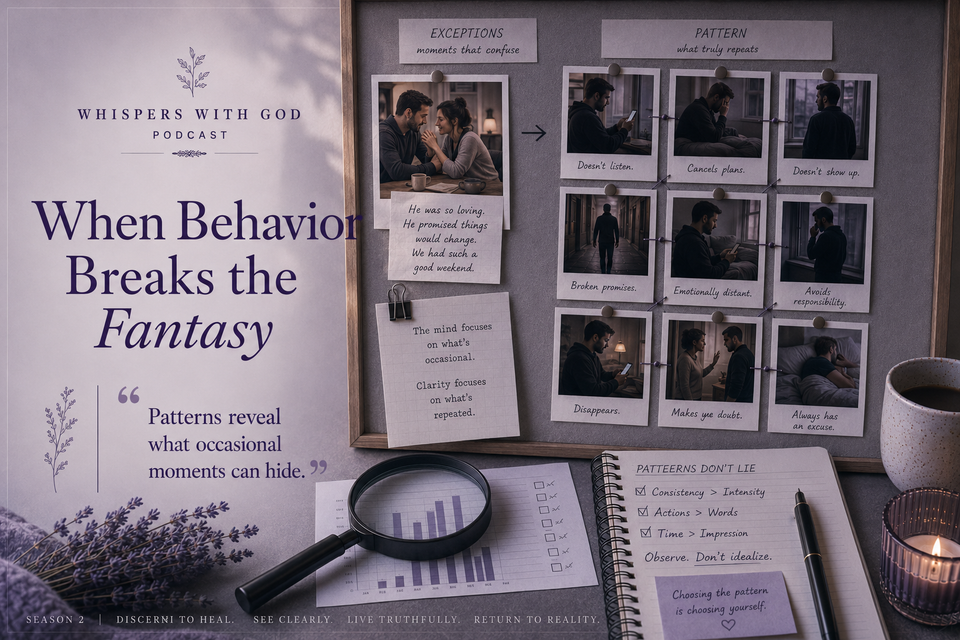
Season 2 continues its movement into discernment by arriving at one of the most painful turning points in emotional clarity: the moment when behavior begins to contradict the story the heart has been protecting.
Illusions rarely collapse all at once.
Most of the time, they do not shatter in a single dramatic revelation. They weaken gradually. Quietly. Through repetition. Through contradiction. Through moments that do not quite fit the emotional narrative we have been holding.
And that is often what makes this stage so emotionally exhausting.
Because the struggle is not simply about seeing uncomfortable behavior.
The struggle is about what that behavior threatens to dismantle.
A story.
A meaning.
A future.
An identity.
A version of reality that once felt emotionally coherent.
At first, the contradiction may feel subtle.
A promise that quietly fades.
A repeated disappointment.
An inconsistency that begins to feel less accidental.
A pattern that creates discomfort without immediate clarity.
And because emotional attachment naturally tries to preserve meaning, the heart often does what hearts do best:
It explains.
Maybe they are stressed.
Maybe I misunderstood.
Maybe they need more time.
Maybe I expected too much.
Maybe this is not what it looks like.
Those interpretations are not necessarily foolish.
They are often sincere attempts to preserve emotional coherence.
Because when something matters to us, we do not immediately want to believe the most painful explanation.
That is profoundly human.
But when contradiction becomes pattern, something deeper begins to happen.
Psychology refers to this as cognitive dissonance: the internal tension created when belief and observation no longer align.
One part of the mind says:
This relationship is meaningful.
Another quietly says:
This keeps hurting.
One part says:
This is who I believe they are.
Another says:
But this is what keeps happening.
And that internal conflict becomes exhausting.
Because the mind does not like unresolved contradiction.
It wants coherence.
And when emotional attachment is strong, the mind often tries to reduce discomfort not by accepting reality, but by negotiating with it.
It minimizes.
It rationalizes.
It reinterprets.
It self-blames.
It explains.
It protects attachment by protecting interpretation.
That may be one of the most emotionally honest realities of attachment.
Because accepting reality does not merely mean reevaluating a relationship.
Sometimes it means grieving everything emotionally invested in the story.
And that can feel like losing far more than the relationship itself.
It can feel like losing meaning.
Certainty.
Hope.
Identity.
Narrative safety.
That is why reality can feel destabilizing.
Not because truth is inherently cruel.
But because truth sometimes interrupts structures we built to feel emotionally secure.
This is where spiritual discernment becomes deeply important.
Because not every emotionally compelling experience leads toward truth.
And not every promising beginning leads toward peace.
This is where the wisdom of Saint Ignatius of Loyola becomes especially relevant. His tradition of discernment teaches us that appearances are not always sufficient. Initial emotional intensity is not the same as spiritual alignment. Not everything that looks hopeful at first leads toward peace.
Discernment requires observation.
Patience.
Pattern recognition.
Honest attention over time.
That is why the invitation in 1 John feels so profoundly relevant here:
“Test the spirits.”
This instruction applies far beyond explicitly mystical experiences.
It applies to emotional dynamics.
Relationships.
Patterns.
Attachments.
Interpretations.
Discernment does not automatically trust appearances.
It asks:
What consistently unfolds over time?
That question changes everything.
Because emotionally attached hearts often assign more meaning to occasional moments than to consistent reality.
A beautiful moment.
A meaningful conversation.
A vulnerable confession.
A promise.
A fleeting glimpse of tenderness.
And while those moments may be emotionally real, occasional moments do not necessarily define the larger truth.
Patterns reveal what occasional moments can hide.
That may be one of the clearest signs of emotional maturity.
Because mature discernment listens not only to words, promises, or emotionally charged moments.
It observes lived reality.
Behavior has a quiet persistence.
It keeps speaking.
And eventually, reality enters the room.
That moment can feel deeply destabilizing because sometimes the mind realizes something before the heart is emotionally ready to accept it.
That delay is painful.
But it is also profoundly human.
The breaking of illusion can feel like grief, confusion, instability, even internal disorientation.
But the breaking itself is not punishment.
It is freedom.
Because God does not reveal truth to humiliate the soul.
He reveals truth to liberate it.
And once reality is clearly seen, healing can finally move forward without illusion preserving attachment.
That is where freedom begins.
If You Want to Sit With This Reflection
- 1 John 4:1 — “Test the spirits”
- Saint Ignatius of Loyola — Discernment and interior clarity
- Psalm 119:105 — Light for honest seeing
- Proverbs 4:23 — Guarding the heart with wisdom
Some reflections feel different when they’re heard.





Member discussion