
What Felt Sacred… Wasn’t Stable
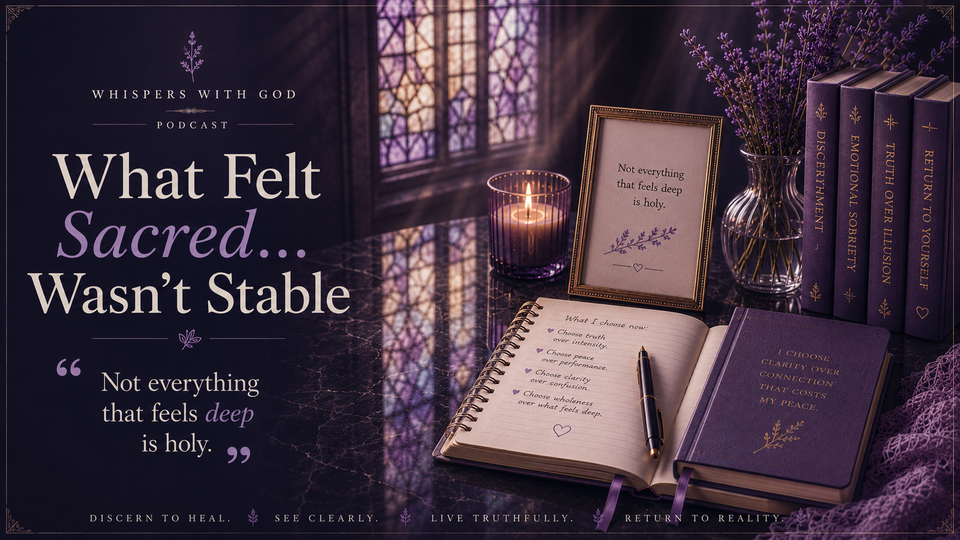
This episode moves the After the Illusion series into even deeper emotional territory.
The first episode explored the quiet surprise of emotional neutrality—the strange realization that something no longer holds the same emotional power it once did.
But this reflection asks a more unsettling and profoundly important question:
What exactly was I attached to?
That question changes everything.
Because human attachment is rarely about the person alone.
Often, attachment forms around meaning.
Representation.
Symbolism.
Identity.
A person may come to represent being chosen.
Being loved.
Being seen.
Being safe.
Being significant.
Movement toward a meaningful future.
And once emotional meaning becomes attached to a person, the grief of losing them can feel disproportionately devastating.
Not because the relationship itself objectively contained all of that.
But because psychologically, it came to represent all of that.
That distinction matters profoundly.
Because many forms of heartbreak are not only relational.
They are existential.
The loss does not simply feel like losing a person.
It feels like losing meaning.
Losing direction.
Losing validation.
Losing identity.
And that kind of grief can feel extraordinarily disorienting.
Because the emotional collapse may not be proportionate to what was actually lost externally.
It may be proportionate to what was lost internally.
Psychologically, this is where symbolic attachment becomes an incredibly important framework.
The mind does not attach only to people.
It attaches to meaning.
That truth explains so much.
Because sometimes what the body reacts to is not the actual person as they truly were.
It is what they came to represent emotionally.
The nervous system may organize itself not only around the person, but around symbolic experiences:
belonging
confirmation
future hope
identity validation
emotional significance
safety
being chosen
And once that symbolic structure forms, disruption feels far larger than circumstance.
Because what begins to collapse is not merely a relationship.
It is an emotional architecture.
This is where the philosophical layer becomes extraordinarily illuminating.
Gabriel Marcel’s distinction between having and being offers remarkable clarity.
Because external relationships can quietly become fused with identity.
What begins as:
I have this connection.
can gradually become:
This connection says something about who I am.
Or even more dangerously:
Because this person chose me, I am worthy.
That psychological shift is subtle.
But devastating.
Because once identity becomes entangled with emotional attachment, the loss no longer feels merely circumstantial.
It feels existential.
The grief becomes not simply:
I lost this.
But:
Who am I now?
That is profound emotional territory.
And spiritually, this episode becomes even richer.
Because Christian spiritual tradition has always been deeply discerning about emotional intensity.
Modern emotional culture often assumes that intensity equals authenticity.
If it feels overwhelming, it must be meaningful.
If it feels profound, it must be real.
If it feels emotionally sacred, it must be trustworthy.
But spiritual wisdom is far more careful.
Saint Teresa of Ávila offers an especially important lens here.
Not everything that feels deep is holy.
That sentence carries extraordinary clarity.
Because emotional intensity can arise from many places:
projection
need
fear
symbolic longing
identity hunger
attachment wounds
idealization
Intensity alone is not evidence of truth.
And that distinction is deeply liberating.
Because it allows compassion without confusion.
You were not foolish for feeling deeply.
You were human.
You were open.
You hoped.
You attached meaning.
But emotional depth alone does not guarantee reality.
This reflection frames disillusionment not as humiliation—but as spiritual correction.
That is such an important distinction.
Because clarity is often misinterpreted as cruelty.
But spiritually, clarity can be mercy.
Sometimes God allows what was falsely elevated to return to proper proportion.
Not to shame the soul.
But to free love from distortion.
That is extraordinarily compassionate theology.
Because the collapse is not meaningless.
It is purification.
This is where Scripture grounds the reflection beautifully.
1 John reminds us:
“Let us not love in word or speech, but in truth and action.”
That matters enormously.
Because emotional language alone is not proof of love.
Emotional intensity alone is not proof of love.
Emotional symbolism alone is not proof of love.
Authentic love requires coherence.
Truth.
Embodiment.
Reality.
And that becomes a profoundly important spiritual criterion.
If words and reality diverge, truth must take precedence.
One of the most painful but clarifying truths in this episode is this:
What actually broke may not have been love itself.
It may have been false meaning.
The emotional mythology.
The sacred narrative.
The identity structure.
That realization hurts.
Because symbolic grief is real grief.
But it is also clarifying grief.
And perhaps the most compassionate part of this reflection is that it refuses shame.
Openness is not foolishness.
Hope is not stupidity.
Love is not weakness.
Those distinctions matter.
Because the goal of discernment is not cynicism.
It is refinement.
Clarity does not destroy your capacity to love.
It refines it.
That may be one of the most beautiful truths in the entire mini-series.
Because healing is not becoming emotionally harder.
It is becoming spiritually clearer.
More discerning.
More stable.
More anchored in reality.
And the closing movement is profoundly hopeful:
the soul does not stop loving.
It simply learns to recognize what is actually stable.
If You Want to Sit With This Reflection
- 1 John 3:18 — Love in truth and action
- Saint Teresa of Ávila — Discernment and interior clarity
- Gabriel Marcel — Having vs being
- Psalm 139 — Truthful self-examination before God
Some reflections feel different when they’re heard.





Member discussion