
The Moment You Realize It’s Actually Over
Some endings do not arrive dramatically.
There is no final speech.
No cinematic confrontation.
No perfect conversation that suddenly resolves everything.
No obvious emotional climax announcing that healing has officially completed.
Sometimes, the end arrives much more quietly.
While driving.
While washing dishes.
While folding laundry.
While sitting in ordinary silence.
And then, almost unexpectedly, something shifts.
Or perhaps more accurately:
something is noticed.
A thought appears—and it does not carry the same weight.
A memory surfaces—and it does not destabilize you.
Something reminds you of what once consumed your emotional world, and instead of spiraling, you simply continue.
And in that quiet moment, something almost surprising becomes clear:
Oh.
This does not hurt the same anymore.
That kind of realization is profoundly beautiful precisely because it is so ordinary.
Healing often does not reveal itself through drama.
It reveals itself through absence.
The absence of urgency.
The absence of emotional orbit.
The absence of compulsion.
The absence of internal chaos.
Not because the past disappeared.
But because your relationship to the past changed.
That distinction changes everything.
Because healing is not forgetting.
Healing is integration.
The story remains.
The memories remain.
Meaning may even remain.
But the emotional authority changes.
What once governed your inner life no longer does.
And that may be one of the clearest signs of real healing.
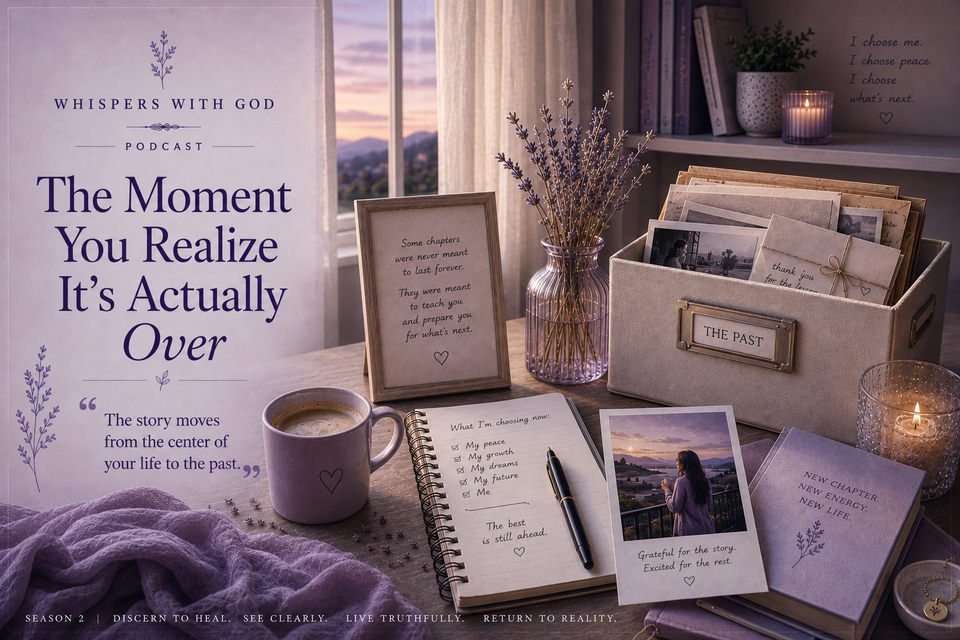
The story moves from the center of your life to the past.
That is not emotional numbness.
It is emotional reorganization.
Psychologically, this is what integration looks like.
The nervous system no longer reacts with the same urgency.
The old loops have weakened.
Reinforcement has stopped.
The attachment has lost its compulsive grip.
Checking no longer feels necessary.
Searching no longer feels urgent.
The story is no longer emotionally feeding itself.
And because of that, peace begins to emerge naturally rather than through force.
That distinction matters.
Because forced detachment still carries tension.
True integration feels different.
It feels quieter.
Softer.
Less performative.
More honest.
This is not pretending not to care.
This is no longer being governed by what once consumed you.
Season 1 taught the mechanics of detachment.
How emotional reinforcement works.
How the nervous system responds to withdrawal.
How regulation begins.
How peace slowly returns to the body.
Season 2 moved into discernment.
Illusion.
Fantasy.
Potential.
Narrative attachment.
Cognitive dissonance.
Acceptance.
And here, in this finale, both journeys quietly converge.
The body settles.
The mind stabilizes around truth.
Attachment weakens.
Peace appears.
Not dramatically.
But genuinely.
Spiritually, this movement is deeply beautiful.
Because at its deepest level, healing is not merely emotional relief.
It is reordering.
Saint Augustine’s words remain profoundly true:
“Our hearts are restless until they rest in You.”
That truth reaches far beyond heartbreak.
Because human beings were never meant to ask finite attachment to satisfy infinite longing.
And much of emotional suffering comes from that impossible burden.
Not because love is wrong.
Not because attachment itself is sinful.
But because when the heart becomes emotionally centered around what cannot ultimately hold it, restlessness follows.
This finale beautifully reframes healing not as emotional emptiness, but as recentering.
The heart returns.
Not to numbness.
Not to cynicism.
Not to isolation.
But to its proper center.
That is deeply Christian healing.
Philippians gives language to this kind of peace:
“The peace of God, which surpasses all understanding…”
That phrase matters because peace does not always arrive when every question has been answered.
Sometimes peace arrives when the need for answers has softened.
That is maturity.
Because closure rarely comes from another person.
Rarely from explanation.
Rarely from apology.
Closure often arrives through clarity.
And eventually, truth becomes enough.
That may be one of the most mature forms of emotional healing.
Not needing the ending rewritten.
Not needing one more explanation.
Not needing the story to change in order for your peace to exist.
The truth is already enough.
And from that place, something remarkable happens.
Life begins again.
Not because the past was erased.
Not because the memories vanished.
But because your life no longer orbits that story.
And that is freedom.
This finale also makes an important distinction.
Peace is not indifference.
It is not emotional shutdown.
It is not bitterness disguised as detachment.
It is not avoidance.
Peace is softer than that.
Warmer than that.
More alive than that.
Peace is what remains when illusion has collapsed, grief has moved through, truth has stabilized, and the heart no longer needs to keep reaching.
That is not emptiness.
That is healing.
And perhaps one of the most sacred moments in healing is not the dramatic breakthrough.
It is the quiet realization:
It’s actually over.
And strangely enough—
that is where life begins again.
If You Want to Sit With This Reflection
- Philippians 4:7 — Peace beyond understanding
- Proverbs 4:23 — Guarding the heart
- Saint Augustine — Restless hearts and proper center
- Ecclesiastes 3 — A time for endings and beginnings
Some reflections feel different when they’re heard.





Member discussion