
Healing Isn’t Closure — It’s Regulation
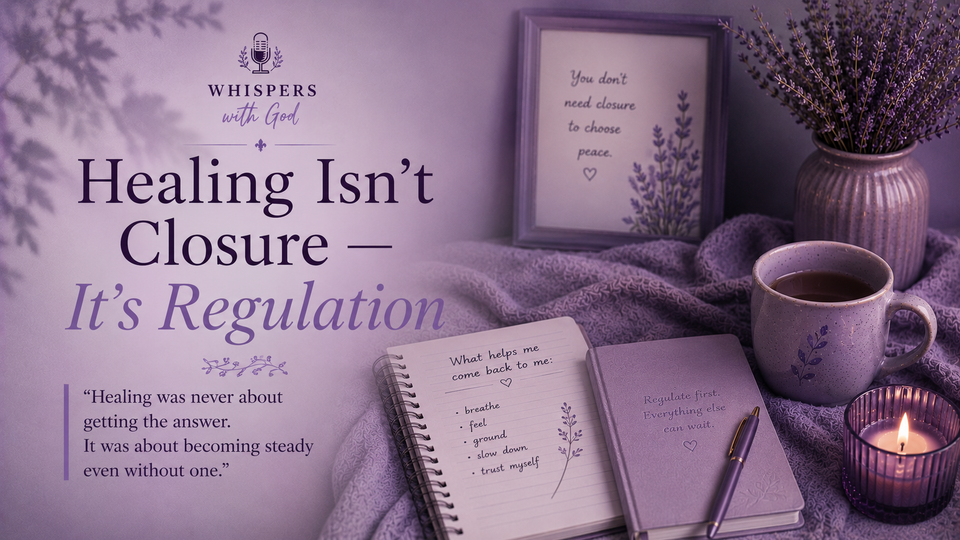
One of the most persistent myths about healing is the idea that peace comes through closure.
That if you could just understand what happened, hear the right explanation, receive the apology, or have one final honest conversation, something inside you would finally settle.
It’s such a human belief, and honestly, such an understandable one.
Because when something hurts, the mind naturally wants resolution. It wants coherence. It wants the story to make sense. It wants answers that organize the chaos.
And sometimes, that instinct can feel almost sacred.
If I just understand this, I’ll finally be okay.
But healing has a way of challenging that assumption.
Because many people have had the explanation and still felt shattered. Many have received apologies and still felt dysregulated. Many have understood the truth intellectually and still felt emotional waves they could not control.
Which reveals something important:
Healing is not always about explanation.
Sometimes it is about regulation.
Closure, as most people imagine it, is the belief that peace comes from explanation. That if the story is organized correctly, the body will finally relax.
But the body does not always respond to information the way the mind does.
Because explanation lives in the mind.
Regulation lives in the body.
The mind processes information.
The body stores experience.
And those are not the same thing.
That distinction changes everything.
Because you can understand something completely and still not feel okay.
You can know why someone acted the way they did and still feel the ache.
You can have clarity and still feel activated.
That does not mean you failed to heal.
It means understanding and regulation are different processes.
And honestly, this explains so much of the frustration people feel.
Because we often try to solve something physiological with something intellectual.
We try to think our way into safety.
We try to explain our way into peace.
We try to reason our way out of emotional activation.
But your nervous system is not primarily asking for logic.
It is asking for safety.
And safety is not always created through explanation.
Especially when the wound itself was not simply confusion.
Because pain is rarely only about “not understanding.”
Sometimes the pain came from inconsistency.
From emotional unpredictability.
From attachment disruption.
From repeatedly hoping and then bracing.
From learning to anticipate instability.
From emotional environments where the body learned to scan, reach, wait, and react.
That matters.
Because if the wound was embodied, the healing must be too.
A final conversation cannot necessarily regulate a body that learned instability.
An apology cannot automatically rewire nervous system conditioning.
Even the most articulate explanation cannot instantly resolve physiological activation.
Because even with the answer…
the feeling still has to be processed.
That can be a hard truth.
Because many of us genuinely believe closure will save us.
That if the missing piece is found, the ache will disappear.
But often what we call closure is actually something else.
An attempt to resolve internal discomfort through external clarity.
And while that desire makes perfect sense, it can quietly keep us reaching outward for something the body must learn internally.
That is where healing begins to look different.
Healing is not the perfect conversation.
It is not the apology.
It is not finally hearing the words you hoped would make everything click into place.
Healing is being able to sit with what is present without immediately needing to escape it.
It is allowing discomfort without treating it like a command.
It is feeling activation without assuming you need to act on it.
It is learning to say:
I can feel this and still be okay.
That is regulation.
And regulation is profoundly different from closure.
Closure says:
Once I understand, I’ll feel better.
Regulation says:
Even if I never understand completely, I can still become steady.
That is an entirely different kind of freedom.
Because now your peace is no longer dependent on another person’s explanation.
Or timing.
Or honesty.
Or emotional availability.
Or willingness to participate in your healing.
That shift is deeply empowering.
And spiritually, I think this is where the conversation becomes even more beautiful.
Because many of us instinctively reach outward when we feel unsettled.
Toward answers.
Toward people.
Toward reassurance.
Toward certainty.
Toward control.
But peace, spiritually speaking, has never really worked that way.
Christ says in John 14:27:
“Peace I leave with you; my peace I give to you. I do not give to you as the world gives.”
That matters.
Because worldly peace often feels conditional.
It says:
Once this gets resolved, I’ll be okay.
Once I get clarity, I’ll be okay.
Once they explain themselves, I’ll be okay.
But Christ’s peace is different.
It does not depend on perfect circumstances.
It does not require external resolution.
It anchors instead of reacts.
And that kind of peace changes how healing is understood.
John 8:32 also reframes something important:
“The truth will set you free.”
But truth is not always another person’s explanation.
Truth is not necessarily their version.
Truth is not their closure.
Sometimes truth is simply seeing clearly without distortion, even when validation never arrives.
That is a different kind of freedom too.
And Saint Teresa of Ávila adds something profoundly helpful here.
Her spiritual vision reminds us that all things are passing.
Feelings pass.
Urges pass.
Activation passes.
Waves rise and fall.
But God does not.
That matters because if we anchor ourselves in what constantly changes, we will constantly feel unstable.
But if we root ourselves in what remains steady, something shifts.
Her image of the soul as an interior castle feels especially fitting here.
Because peace is not something we chase externally.
It is something we return to.
The center is already there.
God is already there.
And every time we keep running outward for closure, answers, or emotional resolution, we quietly move away from that center.
But healing invites a return.
Not toward denial.
Not toward emotional numbness.
Toward groundedness.
Toward stability.
Toward interior steadiness.
This is also where identity changes.
Because eventually, healing is not just about feeling differently.
It is about becoming someone different.
Someone who does not chase understanding in order to feel okay.
Someone who does not abandon herself in pursuit of reassurance.
Someone who can hold discomfort without losing direction.
Someone who does not confuse unanswered questions with emotional emergency.
That is growth.
And practically, this changes the internal language.
Instead of:
I need closure.
The language becomes:
My body is asking for regulation.
That is such a different conversation.
Because now the response is no longer compulsive reaching.
It becomes presence.
Breathing.
Grounding.
Prayer.
Witnessing the wave without obeying it.
Staying.
Returning.
Re-centering.
And every time you do that, something is changing.
Not because you got the answer.
Because you became steadier without it.
That is healing.
So no—healing is not necessarily closure.
Healing is regulation.
And perhaps one of the most freeing truths of all is this:
You do not need every answer to move forward.
You need enough clarity to stop abandoning yourself.
And enough steadiness to keep walking.
If You Want to Sit With This Spiritually
- John 14:27 — Peace not as the world gives
- John 8:32 — Truth that frees
- Psalm 46:10 — Be still and know
- Saint Teresa of Ávila — Let nothing disturb you
Some reflections feel different when they’re heard.





Member discussion